
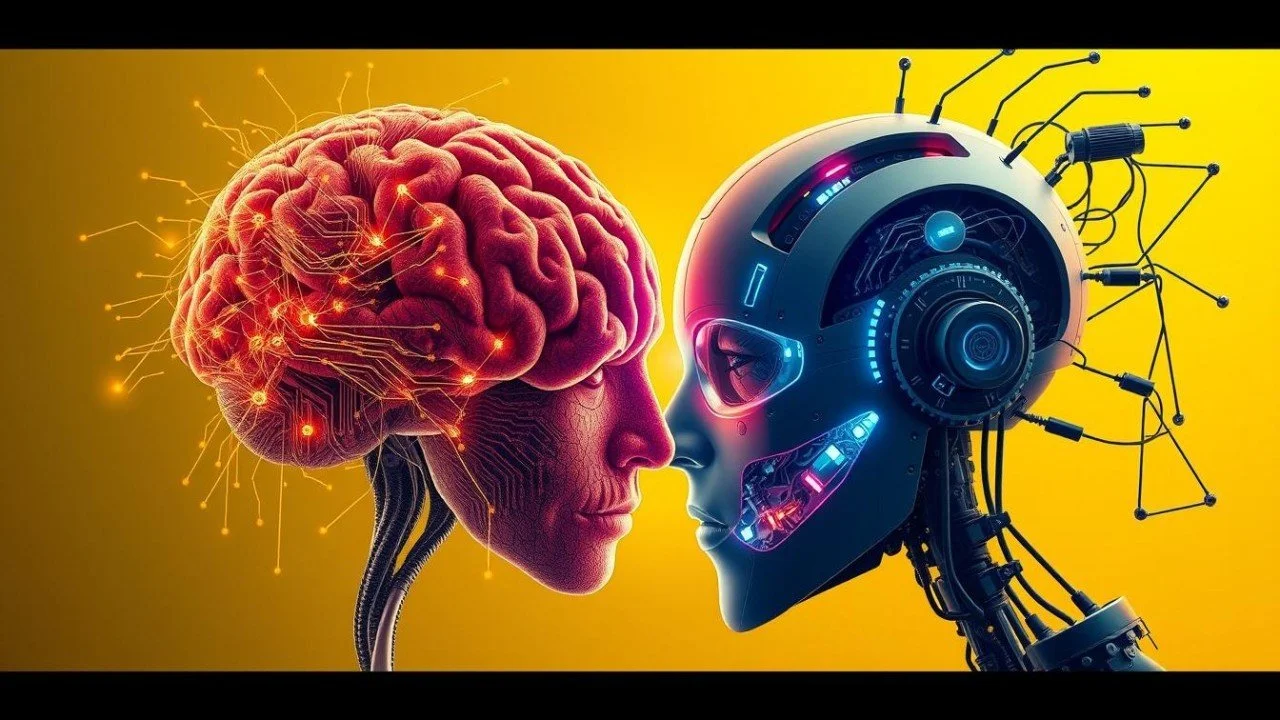
Several of my previous “human intelligence” (HI) blogs have discussed environmental impacts from artificial intelligence (AI) hyperscale data centers. Here’s a blog I wrote after a local proposed data center application got withdrawn and when I asked an AI chatbot prophecy about pros and cons in five years. Data centers are the new factories for producing AI Large Language Models (LLMs) that are rapidly changing our lives. In this changing landscape, can we maintain our individual, creative intelligence that makes us human? Can we continue to think independently or will we succumb to the powers of computer algorithms to make decisions for us?
Humans have developed tools for survival as well as devices that can lead to our own destruction including burning fossil fuels promoting greenhouse gas with atmospheric warming causing climate change (which is becoming more severe to provide power to AI hyperscale data centers) as well as past and likely future use of nuclear weapons. After the United States dropped atomic bombs in Japan to end World War II, the Eisenhower administration created the Atoms for Peace program that inspired Project Plowshare that ran until 1977. According to LLNL, atomic bombs were detonated outside of the Nevada Test Site including in five states to promote natural gas extraction or harbor expansion. These “peaceful” applications caused tremendous damage and radioactive sites are still being managed under the Department of Energy’s Nevada Offsites program. Are we in a similar environment today with AI as people are rushing to promote beneficial uses without considering the long-term impacts to people and our society?
Bill Gates, co-founder of Microsoft, says AI is much more dangerous than nuclear weapons! In an interview with Ezra Klein, Gates believes governments must act quickly to prevent catastrophic cyberattacks, bio-terrorism and mass job loss because current open source AI models can be misused by evil people.
Stewart Townsend on his LinkedIn blog (where I obtained the cover artwork) states:“The human brain is amazing at creative thinking and innovation. We can come up with new ideas and solutions through imagination. This is something AI can't do well.” So the author encourages us to keep using our brains!
I wonder where Human Intelligence (HI) is now and will be in the future making decisions which impact every part of our world including careers, education, economy, law enforcement, privacy, scientific facts, and much more. One way to evaluate the importance of HI is to read books written about social changes occurring before the advent of AI.
The Fountainhead by Ayn Rand follows the life of Howard Roark, a genius architect who creates new modern styles of buildings that fit into their landscape. He exemplifies individual accomplishment to such an extent that he refuses to compromise his artistic integrity by mixing ancient styles. The antagonist, Peter Keating, who attended the same college copies popular styles and relies on Roark and others to support his work. When a government housing project designed by Roark at the request of Keating is substantially changed, Roark blows up the empty construction site! During the trial, Roark defends himself:
“Man cannot survive except through his mind. He comes on earth unarmed. His brain is his only weapon. Animals obtain food by force. Man has no claws, no fangs, no horns, no great strength of muscle He must plant his food or hunt it. To plant, he needs a process of thought. To hunt, he needs weapons, and to make weapons - a process of thought. From this simplest necessity to the highest religious abstraction, from the wheel to the skyscraper, everything we are and everything we have comes from a single attribute of man - the function of his reasoning mind.”
“But the mind is an attribute of the individual. There is no such thing as a collective brain. There is no such thing as a collective thought. An agreement reached by a group of men is only a compromise or an average drawn upon many individual thoughts. It is a secondary consequence. The primary act - the process of reason- must be performed by each man alone. We can divide a meal amongst many men. We cannot digest it in a collective stomach. No man can use his lungs to breathe for another man. No man can use his brain to think for another. All the functions of the body and spirit are private. They cannot be shared or transferred.”
“Nothing is given to man on earth. Everything he needs has to be produced. And here man faces his basic alternative: he can survive in only one of two ways - by the independent work of his own mind or as a parasite fed by the mind of others. The creator originates. The parasite borrows. The creator faces nature alone. The parasite faces nature through an intermediary.”
“Now observe the results of a society built on the principle of individualism. This, our country. The noblest country in the history of men. The country of greatest achievement, greatest prosperity, greatest freedom…based on the right to the pursuit of happiness.”
“Now, in our age, collectivism, the rule of the second-hander and second-rater, the ancient monster, has broken loose and is running amuck. It has brought men to a level of intellectual indecency never equaled on earth. It has reached a scale of horror without precedent. It has poisoned every mind. It has swallowed most of Europe. It is engulfing our country.”
The author Ayn Rand of Russian descent, wrote these ideas in the mid 1930’s during the rise of Nazi Germany spreading through Europe. She contrasted communism, socialism and capitalism to became a champion for free enterprise and government deregulation. I wonder what Ms. Rand would say about AI or now what the Trump Administration is calling Super Intelligence (SI)? Just like many people are opposed to rebranding the Gulf of Mexico, Alaska’s Denali, and Lake Ontario, my HI prefers continuing to refer to large language models as AI. I imaging Ms. Rand would expect corporations to be responsible without government regulations to prevent AI from becoming embedded in our brains like parasites and advocate for humans to be self-reliant and independent thinkers.
Consider that there are several AI companies and nations fighting for who will achieve the “best” AI system. Recently, several incidents of AI chat bots (cited in The Guardian) have been illegally hacking into other companies and nations systems! AI can be misused to produce AI slop and deep fakes or used solve important problems. AI has the potential to be ruin or rule the world. Will we retain our right to use our brain for thinking or will we defer all our memory and thoughts to AI?
I see people are mesmerized if not hypnotized by their “smart” phones. I went to the gym the other day exercising on the second floor elliptical machine, I could see people distractedly walking down the stairs in front of me staring at their phones but not using the hand rail. One lady had both hands full looking at her phone with a water bottle under her arm until on the first step down she dropped the metal bottle that fell bouncing and banging down the stairs getting everyone’s attention! I’m glad nobody fell down the stairs.
Computers can be useful tools for humanity as long as we can continue to be the creators of our own destiny! If you feel motivated, please speak out to elected officials or join a local group to become aware of where AI hyperscale data centers are being planned in your area. The Brockovich AI Data Center reporting map of the U.S. shows over 300 operating or under construction and another 175 data centers proposed. Meanwhile, SpaceX proposed to the FCC to launch one million AI satellites! Environmental groups are raising the alarm that NEPA reviews are needed to evaluate likely impacts including nighttime light pollution and satellites falling back to Earth.
Updated October 11-13, 2026
What happens when AI companies decide to demonstrate their power by solving the most complex problems in math and science? Does that make people smarter having the answers or will that make us weaker in the long run? Recently, OpenAI says they solved many math problems including a $1 million Millennium Prize that are causing many professors to speak out:
BusinessInsider: “An NYU professor says OpenAI's mass release of math papers wiped out early-career researchers' projects.” Hear Professor Tristan Buckmaster discuss how he suspects OpenAI accessed his private work and the work of graduate students potentially ruining many people’s careers and the math and science professions!
Professor Gio on YouTube: Professor Giordano Scarciotti with Imperial College in London discusses potential devastating consequence of AI's growing capabilities in the video “You Truly Don't Understand What Just Happened to Mathematics.” I like how he describes the real value of mathematical research often lies in the discoveries made along the way and cites some important examples.
Now for some comic relief, see Saturday Night Live’s Weekend Update with “Mr. Wonderful on Building an AI Data Center in Utah.”
Updated October 18, 2026
According to Yuval Noah Harari, professor of history at the Hebrew University of Jerusalem who wrote the bestselling book, Sapiens: A Brief History of Humankind, he frequently lectures on societies and world history. His wisdom is refreshing in terms of family relationships, finding ways to peace in the world including Middle East, and his description of how AI is not a tool but an agent. Check out his latest interview: AI could lead to the collective dementia of humankind.
Dr. Harari argues that AI will become super-intelligent in a completely alien and non-human way. He says,"It's like a knife that can decide by itself whether to cut salad or commit murder." What will be the consequences if we lose control? The interviewer from the Czech Republic asked, “So, what's the most important asset in the current world?”
Dr. Harari responded, “I would say trust. Now trust is the ground on which we all stand. It's the basis for civilization is not intelligence. The basis for civilization is trust and we are losing it or more correctly trust is migrating from humans to AIs to algorithms. Humans are losing trust in each other. They are losing trust in human institutions in human media in human governments in human banks. And instead they increasingly trust only the algorithms, only the AIs. What am I experiencing right now? Am I experiencing a collapse of the world that we have known for centuries, for millenniums.
“AI is not a tool. It is an agent. An agent is something that can make decisions by itself and invent new ideas by itself. even something that the creators did not want or understand. Especially something that the creators didn't didn't want or intend. I mean, if you can predict everything that an AI will do, then what do you need it for? You already know everything it knows. Why are trillions of dollars, not not millions, not billions, trillions of dollars are now invested in AI? The whole US market is one big gamble on AI. If AI could only do what we already know how to do, why spend so much money? They assume the AI will be able to do things that we cannot and that we cannot even predict. This is why it's all it's so valuable. But if it can do that, how do we keep it under our control?”
Dr. Harari compares how a cow sold to market does not know about the money exchanged in the transaction will be similar to when AI takes over financial systems we will lose control over trust in money. “They will take over the bureaucracies like the financial system, create much more sophisticated financial systems and legal systems that we can't understand. So just as cows can't understand the financial system that controls their lives today, we will not be able to understand the AI financial system that will control our lives in 10 or 20 years.”
Dr. Harari also comments on Big Tech battles between the US and China, with some leaders like Elon Musk influencing elections in Europe. In July 2026, Elon Musk stated during an interview with The Economist that "money won't matter by 2036" due to rapid advancements in artificial intelligence and humanoid robotics and on most days he goes from exhilarated to terrified about the future of AI.