
This blog describes noise pollution health impacts from data centers in order to review proposed ordinance requirements being drafted by the Town of Apex, NC. Here’s a summary:
We cannot hear low hum infrasound below 20 Hertz but people exposed may experience health impacts including dizziness, discomfort and stress. These sounds travel further (beyond one mile) than noise we can hear, are difficult to mitigate, and are rarely monitored or regulated by town ordinances.
Data center equipment also produces loud whining noise typically 20 decibels or more above ambient levels, can be partially mitigated with sound barriers and are occasional regulated but difficult to enforce and noise typically exceeds ordinance requirements.
Combined health impacts include dizziness, discomfort, stress, chronic sleep deprivation, anxiety and depression, increased blood pressure, cardiovascular symptoms, heart attacks, and strokes!
Pets, wildlife and farm animals are more sensitive to noise and vibration but are not considered in most noise ordinances.
Noise from industrial construction of hyperscale data centers is more intense and prolonged than from building housing developments but is not considered in most noise ordinances.
Recommend collecting background noise, vibration, weather (and other environmental) information months before permitting and construction begins.
I suggest taking about 45 minutes to listen to the following videos to hear the impacts of noise occurring from data centers.
YouTube videos (apologize for the annoying advertisements):
Data Centers Behaving Like Acoustic Weapons by Benn Jordan on 2/18/2026
Very informative 30 minute video by noise expert who describes full spectrum noise created by data centers with interviews and conducts experiments on people documenting noise-related health impacts. Huge cooling systems, backup generators, and rows of industrial HVAC units in data centers produce constant ground-borne vibrations and low-frequency airborne hums (infrasound). Recommends pre-construction monitoring baseline with Raspberry Shake for daily log of vibrations.
Neighbors say noise from Michigan data center is 27/7 and upending their lives WXYZ-TV Detroit 7/23/2026
A 7 minute video describing Hyperscale Data that is expanding without permits from crypto currency data mining to become an AI hyperscale data center. Interviews with residents who describe the high pitched noise like loud vacuum machines that are clogged. Another person compares it with a torture chamber; a professor associates data center noise with high blood pressure, heart attacks, and strokes; a lawyer filed suit for neighbors living in a historic area. On March 9, 2026, the City of Dowagiac, Michigan passed a noise ordinance but with high limit of 65 db(A) measured at the residential property.
What’s that sound? It’s Mount Pleasant’s new AI data center WISN-TV 12 News Wisconsin
Short video stating when Microsoft began constructing a $3.3 Billion AI data center in late 2023, residents who supported the initial data center construction became alarmed when the high pitched noise got inside their homes 24/7 and with additional data center expansion causing noises to get louder.
Debilitating white noise: Data center neighbors complain about high-pitched sounds ‘all the time’ WUSA9, Washington, D.C. 4/6/2026
Short video interviewing neighbors living by the Vantage data center in Sterling, Virginia who say the high-pitched noise is like having a headache all the time. People don’t like being outside anymore. They generate their own power with 8 natural gas turbines. Residential noise exceeds ordinance of 55 dB and the county supervisor wants to see noise levels reduced (if possible).
The Town of Apex, NC is developing a noise ordinance to prepare for future AI hyperscale data center applications. Despite widespread community opposition that lead to the previous applicant moving on and the town enacting a one-year moratorium, some town leaders and the planning department appear to be excitedly pushing forward with making requirements in the form of adding and amending an ordinance.
On October 7, 2026 the Apex Environmental Advisory Board (EAB) Data Center Subcommittee got an hour and 40 minute presentation (see time markers below) from Mr. Bruce Venable with the planning department staff who is writing the noise ordinance. Members of the public are not invited to speak at these meetings.
Here are a few of his comments (min 13): “We're going to talk about noise types and sources for data centers. So, we're just talking about noise types. I'm going to start off by letting you know, and it's probably pretty obvious, I am not an engineer, a mathematician, or anyone who deals with uh some of these complex things. So, I'm going be doing my best to kind of give you the layman understanding of some of these. So if there's any questions I can't answer, I'll be happy to reach out to someone who can answer them for you. Um, but we'll try and get through this as best we can with all of our expertise in the room.”
The meeting did not have any noise experts to ask or answer questions! The planning department said they would hire an expert consultant over 13 months ago and never did! So the advisory board and the town have no noise experts preparing, presenting, reviewing and advising the town for creating new requirements.
Mr. Venable continued, “So the way the reason data center is different kind of touched on is that the continuous noise 247 for most of these facilities is really going to have an impact especially on people who maybe they don't hear it when they're at work or they're away or they're at school but when they get home and they're trying to relax or spend time with their family that constant noise is there and it can be a little detrimental to their health.”
He drastically minimized the health consequences omitting readily available information. See the bulleted information at the top of this blog to see if you agree that increased risk of heart attacks and strokes are “a little detrimental to their health!”
After about two minutes discussing sound frequency basics, Mr. Venable showed sources of data center noise and possible mitigation measures. At min 20, he showed factors that influence noise migration including weather, humidity, and temperature. Then he discussed a study in Virginia by Dr. John Lyver showing most of the data centers will exceed db(A) noise limits imposed by counties. I provided that study to Mr. Venable on August 25th which he said he already had but he did not share another study I sent him from Dr. Benjamin Xie that contains important information: Coloradans Should Require Data Center Measurements They Can Trust. The study from Dr. Xie states:
“Existing Colorado laws do not effectively regulate data center noise because of their low frequencies. Colorado’s maximum permissible noise levels (§ 25-12-103) are measured according to db(A). This measure biases towards audible, higher frequencies, as shown by the curved red line in the figure below. This method of measurement under-reports lower frequency noises associated with data centers by over 10 db. Therefore, existing laws do not effectively regulate low hums which come from data centers. In response to this, Weld County added a db(C) noise limit of 65 dB(C) at the property line, although it is unclear if this threshold is appropriate.”
To understand the differences between db(A) and db(C) in addition to Mr. Venable’s presentation, the Industrial Noise & Vibration Centre shows how the db(A) filters out noise that is not audible on the db(C) scale.
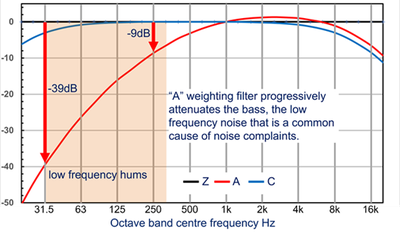
When compared to db(Z) and db(C) weightings, db(A) underreports low frequency hums which data centers emit (INVC)
Here’s a summary and recommendations provided by Dr. Lyver that Mr. Venable shared at the meeting at min 24:
A. Summary
Prince William County government is not fulfilling its obligations to residents by developing reliable noise projections for proposed data center rezoning proposals before approving those proposals.
Within northern Virginia, there are widely varying noise ordinance specifications between counties and locales which afford residents widely varying protections from 24/7 data center noise levels.
County government staffs lack sufficient expertise for crafting thorough-going noise ordinances without loopholes which industrial and commercial activities can exploit to circumvent the intent of noise ordinances.
B. Recommendations
Prince William County (PWC) government needs to take seriously its obligations to protect its residents from intrusive noise levels.
PWC needs to develop reliable and validated noise analysis methodologies and measurement capabilities for proposed data center rezoning proposals before approving those proposals.
Until PWC has this secured these noise modeling and measurement capabilities, the county should impose a moratorium upon all further data center rezoning proposals.
PWC needs to modernize its dated noise ordinances for digital-era industrial activities. PWC should survey statewide and nationwide noise ordinances and develop a best practice noise ordinance which affords PWC residents the protection from 24/7 data center noise levels which they deserve.
Further, PWC needs to craft a thorough-going noise ordinances which eliminate loopholes which industrial and commercial activities can exploit to circumvent the intent of noise ordinances.
PWC government needs to invest in its staff and develop greater in-house noise modeling and measurement expertise.
Town of Warrenton (ToW) needs to establish a standardized set of locations to take readings around the proposed DC and needs to formally record a baseline set of readings for those locations.
Several of the recommendations to be followed are also needed of the Apex noise ordinance including expertise, methods, measurements, and communications.
At min 38, Mr. Venable shared benefits of noise barriers and expressed the need for a consultant. The Industrial Noise & Vibration Centre (INVC) shows that several of the recommendations made in the Apex draft ordinance are not needed or ineffective. For example, the draft Apex ordinance states, “A single broadband number can hide one loud, narrow band. Third-octave band measurement makes that band visible.”
The INVC states conversely, “In addition to complex narrow band analyses, standards also suggest that tones can be evaluated by a) listening or b) using 1/3 octave analysis. Unfortunately, our experience is that people (even noise consultants) can be very bad at judging tones by ear and 1/3 octave analysis is ancient tech that is very unreliable as a tone detector. Now you can either buy spectrum analysis software (at moderate cost) or simply download a very effective free smartphone app. According to the 1/3rd octave method, there are zero tones in this plot - which is completely wrong... Why would you use a 1960's analysis that is unreliable when you could use modern (free) app alternatives that are both accurate and precise?”
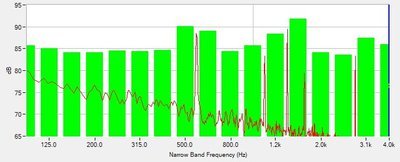
According to the 1/3rd octave method, there are zero tones in this plot (INVC)
At min 45, the draft ordinance was shown too quickly to read but is provided on the EAB website for documents (see October list).
Definitions in the ordinance are critically important:
Noise-Sensitive Use: a school, child care center, hospital, nursing or assisted living facility, place of worship, public park, greenway or [conservation area].
These seem very specific and omit other places that could be impacted including in the Jordan Pointe gather place that includes a cabana, dog park, mailboxes, playground, swimming pool all located about 1300 feet the previously proposed AI hyperscale application site property line.
Protected Property: any lot zoned or used for residential purposes, and any lot containing a Noise-Sensitive Use, whether or not the lot is developed.
Town Acoustical Consultant: an independent acoustical engineer selected and retained by the Town and paid from funds provided by the applicant or Operator. The consultant may not have worked for the applicant, the Operator or an affiliate within the prior [3] years.
Independent preparation. The Town Acoustical Consultant shall prepare the plan's survey, modeling and compliance findings, or independently verify them. The applicant pays the full cost.
Unfortunately, not having the consultant available to draft and discuss the ordinance would lock in these requirements that are not sufficient! If I’m a noise expert consultant, I would not want to be responsible and liable for following the proposed Apex noise ordinance.
The zoning and land use of every property within [1 mile], and the location of every Protected Property within [3,000 feet]. Lots of uncertainty in the requirements shown in bold! The proposed 1 mile (5,280 feet) property distance and 3,000 feet to a protected property is much too far to be protective of neighborhoods in the New Hill area!
Points of Compliance. The plan shall designate Points of Compliance as follows:
1. At least one in each direction in which a Protected Property lies within [3,000 feet] of the Data Center Facility. There is no maximum, and the Town may designate more.
2. On the facility property line facing each Protected Property, and 25 feet from the exterior wall of the nearest dwelling or Noise-Sensitive Use in that direction.
3. Locations shall be confirmed, with written access, before the plan is filed. Tentative locations are not accepted.
4. If an owner or tenant refuses access, the point moves to the next-closest Protected Property or to a location at about the same distance and direction.
Why is the Town of Apex proposing compliance to be measure at properties or protected areas instead of at the Data Center property lines?
Civil penalties. Penalties are up to [$TBD] per day for Tier 1, [$TBD] for Tier 2 and [$TBD] for Tier 3.
Mr. Venable said South Carolina is proposing penalties between $10,000 to $35,000 per day of violation. These amounts seem very small in comparison to the revenue of trillion dollar tech companies.
Table 1. Maximum Facility Sound by receiving property (values in [#] subject to change)
Receiving property Daytime (dBA) Nighttime (dBA) Day and night (dBC)
Protected Property 55 [40] [60]
Commercial, office, institutional or agricultural 60 55 [60]
Light industrial 70 65 [60]
Industrial 80 75 [60]
As a train whistle sounds disturbs the meeting, new Board member Kimberly Pierson who works as an electrical engineer asked (at 1 hr 18 min): “Have we looked at ASHRAE standard 90.4?”
Mr. Venable replied: “No, because I do not have access to the manual. I cannot I cannot get access to it.”
Ms. Pierson responded, “Would you like me to purchase it?”
Board member John Garrison whose term expires soon said, “Um, well, we have a tiny bit of money left in the budget.”
Mr. Venable responded, “Let me I let me reach out.”
Ms. Pierson continued, “If we need to purchase it, it's $178. Um, but I my thought is that that would probably be a fabulous, this is our baseline and then we can decide what need to be above it especially because smarter people than all of us have done all that research and written it.”
Mr. Venable replied, “I agree 100% and I have spent a lot of time trying to find um there will be no free copy of it actually very protective of their PDF.”
Wow, the town planner does not know what documents are needed so is not gathering the important documents needed to write the noise ordinance!
TBD: Transcript of Community Meeting on October 14th with Mr. Bruce Venable will be added and has not been distributed as of October 18th.
As a result of the meeting on October 7th, where Mr. Venable spoke to the EAB-Data Center subcommittee but members of the public have not been invited to speak, and the October 14th community meeting involving four residents with Mr. Venable, I felt it urgent to attend the next opportunity to speak in public which is my least favorite activity in the world. I thought that would be the next Town Council meeting on October 27th. The next morning on October 15th, I woke up earlier than normal to prepare a draft speech. Then I reached out to several people wanting to talk on the weekend about what I might say. However, I later learned that morning there would be a meeting of the EAB that evening where I should speak. Mr. Venable never mentioned that meeting (but I want to check the transcript when it’s available). So I spent many hours to rush to give a maximum of 3 minutes to speak at the full EAB meeting on October 15, 2026 at 6:00 pm.
Initially we met on the second floor council chambers but they decided to move to the third floor for an informal meeting. I signed up as the only public speaker and only member of the public to attend in person. The video was on YouTube livestream.
As the video begins with my name being announced at 19:30 min, the staff person said I could not use the podium to address the EAB in front and had to stand behind the U-shaped tables where the audio would be better. As I began to speak, I got nervous and felt naked! I had to hold my notes up close to my waist without shaking. With ASD, when I get anxious its hard to breath and to speak. For me it depends on the receptiveness of the audience and I’m fine when I’m talking in a classroom. Speaking at the EAB meeting felt to me like a hostile work environment and from the video you can see the range of “receptiveness” of some of the people on the board!
Looking at the camera far in the front of the room, I needed to speak from behind a board member sitting with his back to me. Some people looked at me and many did not. Some seemed disinterested and uninviting. Mr. Venable sitting next to the podium is never shown in the video and I could tell he was not looking at me. Mayor Pro-Tempore Terry Mahaffey sat on the right front and I felt seemed to be staring me down but he is not shown on the camera.
I stated, “I’m here to discuss the subcommittee on Data Centers meetings that have not been well publicized, attended and only recently have they been recorded for review. I missed the meeting on water topics which was not recorded. Why should the public bother attending subcommittee meetings when we are not allowed to speak nor have copies of slides and documents that are provided to the board? It’s much easier to wait for the YouTube video if it gets recorded. Recall this EAB committee voted to approve the Natelli application last November immediately after the developer made a slide presentation but with no public input.
On September 18, 2025 – about 13 months ago - I attended a small Apex planning committee meeting discussing the Natelli application. Dianne, the planning department manager, said the town needed to hire a noise expert ASAP because no one is available on staff. Randy the town manager said frequency and tone are important and not just decibel levels which the police get called to enforce. Terry on the Town Council mentioned enforcement for data centers operating 24/7 would be much different than calling the police for a loud party. We discussed that an independent noise consultant would be needed to write the ordinance.
Apparently, that never happened during the seven months before the application got withdrawn by the developer in early March of this year. The purpose of the subsequent one-year moratorium was to gather better informed and develop documents including a noise ordinance. There are many other topics that should be discussed such as artificial intelligence.
Last Wednesday, Bruce Venable presented to the EAB Data Center subcommittee a review of noise technical information and a draft ordinance. He acknowledged that he is not an expert in this area and wanted to present the information as a lay person. I noticed the YouTube video has 120 views so far!
Yesterday, we joined the community Teams meeting led by Bruce to discuss these issues where we learned the Planning Department is fast tracking the noise ordinance apparently because two current board members terms will expire at year’s end. The town plans to have the ordinance in place before new applications are submitted with a future noise consultant locked into monitoring and enforcing the ordinance to be paid for by the developer. So I hope others agree this does not make sense. I suggest slowing the process to draft the ordinance so there can be more public discussions on noise and other environmental issues.”
I got a message from a friend saying, “Good talk Bill. But the acoustics in the 3rd floor room suck.”
Due to the 3-minute time constraint, I left out other important parts of my talk:
Bruce showed the importance of capturing low frequency noise produced by data center equipment called dBC as well as the normal dbA scale for higher frequencies and a one-third octave band are proposed. I previously provided him and the subcommittee with information showing other places like Weld County, Colorado are also requiring dBC limits of 65 at property lines that he did not share.
Instead of property line compliance, important measurements are uncertain in the draft ordinance like points of compliance, distance of protected properties – maybe 3000 feet? The draft ordinance contains a prescriptive noise mitigation plan. The violations for exceeding limits have not been established or reviewed by the legal department.
The draft ordinance does not account for construction noise that would be much more intense and prolonged than for a normal housing development. Currently the point of compliance is not the industrial property line but defined as sites having noise-sensitive uses which can change in the future such as schools and parks but do not include homes, swimming pools, and playgrounds like at Jordan Pointe or the new Ashland Homes!
The regular business moved on for Mr. Mahaffey to recommend people going to early voting and he pointed at me (after he saw the I Voted Early sticker on my shirt) and said “This guy voted.” (Guess he already forgot my name). They discussed new rules for advisory board members that everyone would need to reapply and there are several vacancies. The Mayor no longer needs to start the process for selection and they will be based on the calendar. At min 35, Mr. Mahaffey complained about the Mayor’s past control over the process. After Mr. Venable briefly spoke about the two subcommittees (Data Center and Tree Canopy), at 40 minutes into the meeting, Mr. Mahaffey spoke loudly (I felt in rebuttal to my comments),
“I will add Bruce you’re modest not to mention it, but like your subcommittee this Bruce’s work is being recognized around the state as a leader for understanding and driving this process and developing rules. A LEED conference I was at people are looking and getting recognized. This isn’t some random, off the wall process. I believe what we’ll see may be the model for where we are for municipalities on the calendar.”
I learned during the meeting later as they reviewed generic development zoning conditions, there were none for noise issues which a board member requested be added for future consideration. I left the meeting after the first break at 7:30 pm and the video is 2 hours and 45 minutes.
The next day, on 10/26/26 I sent an email and quickly got a response within a few hours from Allen Coleman, Apex Town Clerk
Dear Mr. Dam,
Thank you for reaching out and sharing your observations regarding last night's Environmental Advisory Board meeting. I'm happy to provide some additional context and clarification.
The Environmental Advisory Board meeting was initially called to order in the Council Chambers before being recessed and reconvened in the third-floor meeting space. This change in location was primarily intended to accommodate a more collaborative work session format, as the majority of the meeting was dedicated to continued discussion of the Board's Suggested Zoning Conditions document rather than formal action items.
Regarding your concerns about audio quality and individuals being off camera, I reviewed portions of the meeting recording, including your public comments and the accompanying transcript. Based on my initial review, your remarks appeared to be both visible and audible, as did the Board's participation during the portions I reviewed. However, I would appreciate a little additional clarification regarding the issues you experienced. Were there specific portions of the meeting where individuals could not be seen or heard clearly? If so, that information would be helpful as we review your concerns.
With respect to the podium, I also observed that Bruce and Nora, both Town staff members, utilized the podium during portions of the meeting. In a work session format, the podium is generally reserved for staff or individuals providing presentations, while Board members typically participate from their designated seating areas. I did not immediately identify instances where Board members utilized the podium during my preliminary review, but I would welcome any additional details you can provide. I also understand your concern regarding the location from which you were asked to provide public comments and would like to better understand whether your concern was related to visibility, audibility, or consistency in the meeting procedures.
Regarding your request for meeting procedures, the Public Forum and Public Hearing Guidelines adopted by the Town Council also apply to Resident Advisory Board meetings. I've attached a copy for your reference. These guidelines address public participation but do not encompass every aspect of meeting operations and procedures. The Town is also developing additional procedural guidance that is expected to be presented to the Town Council for consideration in the near future. In the meantime, if you have questions about any particular procedure, I'm happy to provide additional clarification.
Lastly, I'll be glad to connect with Councilmember Reese regarding his availability next week or the following week. To help facilitate that request, could you share a little more about the purpose of the meeting, anticipated length of time, and whether you would prefer to meet in person or virtually? Having that information will help with coordinating schedules.
I appreciate you taking the time to reach out and share your feedback. We certainly want our public meetings to be accessible and conducted in a manner that supports transparency and meaningful public participation.
I hope this information is helpful, and I wish you a wonderful weekend!
Allen Coleman, CMC
Town Clerk
Town of Apex, NC
Town Clerk's Office
(919) 249-1260 (O) | (336) 583-6223 (M)
www.apexnc.org
Updated 10/19/26
Dear Mr. Coleman:
(I already sent him this first paragraph) Thank you so much for your helpful and timely response to my questions Friday afternoon regarding the previous EAB meeting. First, I would like to schedule a meeting with Mr. Shane Reese at his office or at a convenient location early this week for about an hour. My schedule is open and flexible. The subject is to discuss his recent single dissenting vote on the Axon drones contract, the data center moratorium process, gaining clarity on his priorities, and my preparing to speak at the next Town Council meeting on October 27th.
Second, regarding speaking at future meetings, we give our address when signing in so is it optional to do so as we begin to speak? One neighbor obtained permission from the Mayor not to provide her address during the public address for her own personal safety. I looked at the 2018 Public Forum and Public Hearing Participation Policy which does not state a requirement for announcing our address after we sign in. You indicated the policy is being revised to present to the Town Council sometime soon. Is there a period of time for open public comments on revising the policy? I would like to know when it gets on the agenda for discussion. Hopefully, my experiences can help improve the policy - is there a point-of-contact making the revisions?
Third, as a result of the meeting on October 7th, where Mr. Venable spoke to the EAB-Data Center subcommittee but members of the public have not been invited to speak, and the October 14th community meeting involving four residents with Mr. Venable, I felt it urgent to attend the next opportunity to speak in public which was the next night at the full EAB meeting.
Fourth, I understand the change in venue enhanced the EAB meeting collaboration. However, from the view of public input, the only chance we have to speak is at the larger EAB meeting. Recall, this EAB committee voted to approve the Natelli data center application last November immediately after the developer made a slide presentation but with no public input! As you know, that resulted in creating the two EAB subcommittees but with rare opportunities for public input.
For some backgound, with a B.S. and M.S. in Geology, I worked 25 years for the Federal Government and continue to work as an environmental consultant. I’ve organized many contentious public meetings around the country on issues including relicensing nuclear power plants that attracted large numbers of angry participants. The U.S. Nuclear Regulatory Commission (NRC) hired a moderator to run meetings to ensure public participation, advertised meetings in advance, and held meet and greet sessions to get to know the participants and allow for 2-way dialogs. For the Advisory Boards, we heard there were vacancies and I’ve been asked to apply.
Fifth, I’ve shown the October 15th EAB meeting video to several people who agree about the poor sound quality and not having everyone shown on camera at least during the public portion of the meeting. This included the planning staff member Bruce Venable who sat for the entire meeting off camera to whom I was addressing many of my comments. I could tell while speaking he was looking down and not at me. Looking at the camera far in the front of the room, I needed to speak from behind a board member sitting with his back to me. Some people looked at me and many did not. Some seemed disinterested and uninviting.
Despite my years of experience and perhaps due to some health issues, as I began to speak I got nervous and felt naked! I had to hold my notes up close to my waist without shaking. When I get anxious, it’s hard to breath and to speak. For me it depends on the receptiveness of the audience and I’m fine when I’m talking in a school classroom as a substitute teacher. Speaking at the EAB meeting felt to me like a hostile work environment and from the video you can see the range of “receptiveness” of some of the people on the board! So some of the AV problems involved standing under the microphone, the location behind the U-shaped table and behind board members, as well as my own challenges to speak in public. Ironic that I was talking about noise issues! Here’s an interesting article from The Atlantic on Performance Anxiety in Great Performers. Also, note an article from last Friday by WSJM that NRC identified a “chilled work environment” exists at a nuclear power plant under construction while the industry must maintain a Safety Conscious Work Environment where personnel and the public feel free to raise nuclear safety concerns without fear of retaliation.
Sixth, after I gave my 3-minute speech, the regular business moved on for Mr. Mahaffey to recommend people going to early voting and he pointed at me (after he saw when I spoke the I Voted Early sticker on my shirt) and said “This guy voted.” (Guess he already forgot my name). They discussed new rules for advisory board members that everyone would need to reapply and there are several vacancies. At around min 39, Mr. Venable briefly spoke off camera which the audio was garbled about the two subcommittees (Data Center and Tree Canopy), Mr. Mahaffey spoke loudly:
“I will add Bruce you’re modest not to mention it, but like your subcommittee this Bruce’s work is being recognized around the state as a leader for understanding and driving this process and developing rules. A LEED conference I was at people are looking and getting recognized. This isn’t some random, off the wall process. I believe what we’ll see may be the model for where we are for municipalities on the calendar.”
The Public Forum and Public Hearing Participation Policy, item 5 states, “This is your opportunity to provide input. This time is for you to speak and council to listen. Neither council nor staff will engage in dialog.” I feel that Mr. Mahaffey contradicted my testimony. I was not given the chance to respond to the difference of opinion and with only 3-minutes I could not discuss specific problems with the draft noise ordinance. Therein is the problem with 1-way conversations.
Seventh, you asked:
“Were there specific portions of the meeting where individuals could not be seen or heard clearly?
I did not immediately identify instances where Board members utilized the podium during my preliminary review, but I would welcome any additional details you can provide.
I also understand your concern regarding the location from which you were asked to provide public comments and would like to better understand whether your concern was related to visibility, audibility, or consistency in the meeting procedures.”