
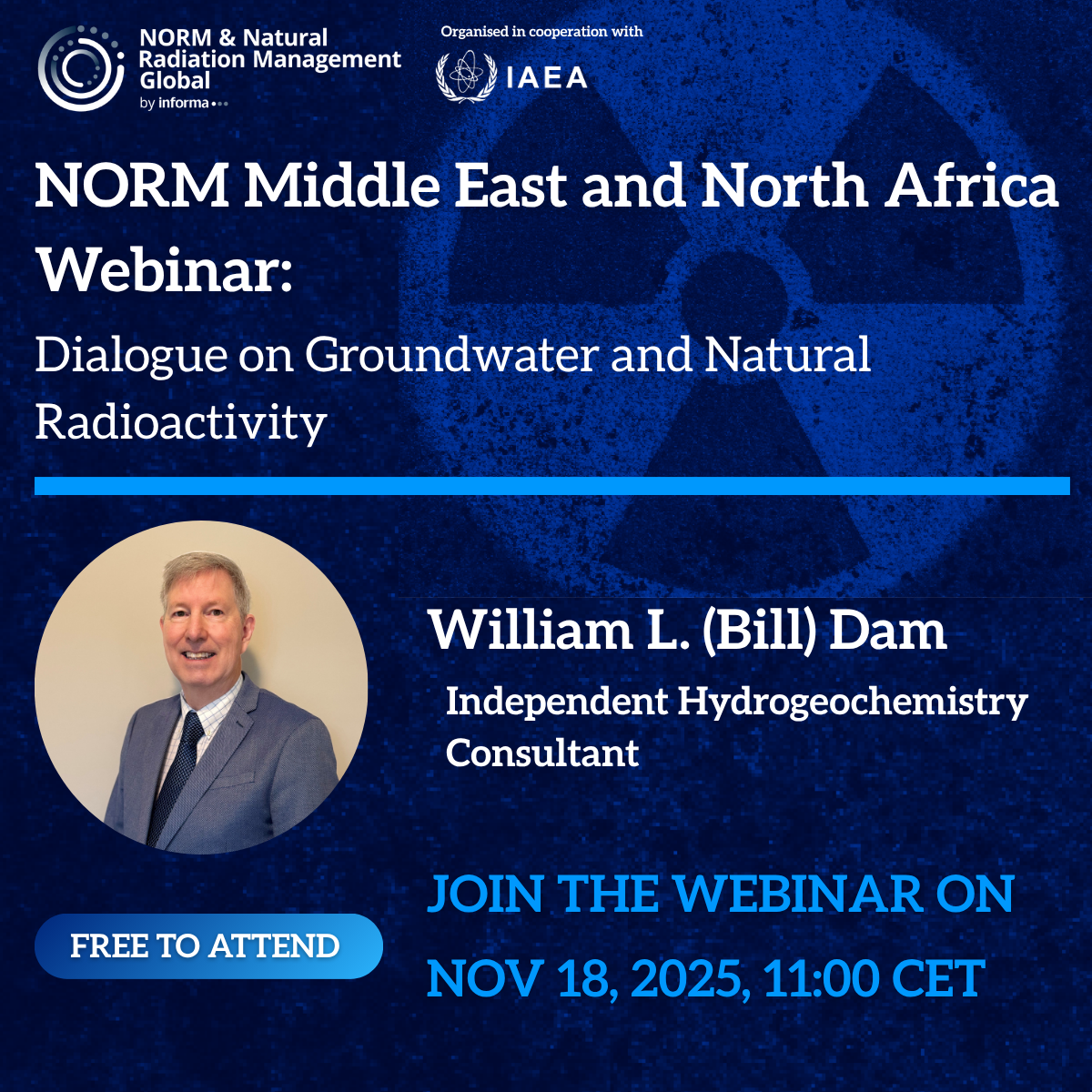
I got invited to speak at the NORM Global Conference (Naturally Occurring Radioactive Materials), happening 20-22 October 2026 in Houston. Here are the event details and agenda sessions here.
I do not plan to attend this conference but their invite reminded me to ask for the video recording from the webinar last year:
NORM Middle East and North Africa webinar: Dialogue on Groundwater and Natural Radioactivity
My talk on the Naturally-Occurring Radioactivity in Groundwater begins at 50:35 and lasts for about 12 minutes.
Naturally-Occurring Radioactive Minerals (NORM), like uranium and thorium, are present in many aquifers in the world impacting drinking-water quality. The lead organizing agency is the United Nation’s International Atomic Energy Agency (IAEA) for the“Dialogue on Groundwater and Natural Radioactivity – Drawing Conclusion & Outcome.”
Here are the most recent publications on radioactivity in the Nubian Aquifer provided to me by Dr. Mahmoud Sherif:
Elevated radium levels in Nubian Aquifer groundwater of Northeastern Africa | Scientific Reports
Radionuclide geochemistry of groundwater in the Eastern Desert, Egypt - ScienceDirect
This paper from Saudi Arabia for Almasoud et al., 2020 : Assessment of radioactivity contents in bedrock groundwater samples from the northern region of Saudi Arabia - ScienceDirect
This is also a great paper by Vengosh et al 2022: A critical review on the occurrence and distribution of the uranium- and thorium-decay nuclides and their effect on the quality of groundwater - ScienceDirect
To prepare for the previous webinar, I reviewed the above papers and met with Dr. Avner Vengosh at his office and laboratory at Duke University. Here’s an except from his 2022 paper
Differential occurrence of naturally occurring U, Ra, Rn, Po, and Pb nuclides in groundwater resources.
The balance between mobilization and retention from and into aquifer rocks controls nuclides occurrence in groundwater.
Aquifer lithology, hydrogeology, and groundwater geochemistry are the major factors that control nuclides distribution.
Distinction between nuclides mobilization associated with chemical and physical (recoil) processes.
Isotope ratios can be used to delineate mechanisms and sources of nuclides mobilization from aquifer rocks.
If you’re interested in my previous IAEA efforts, please see three related blogs describing trips to Jordan in 2018, Saudi Arabia in 2019, and the IAEA headquarters in Austria in 2020. For the Jordan trip, I gave this slide presentation to the 9th International Symposium on Naturally Occurring Radioactive Material.
Report to IAEA from Mahmoud Sherif on Libya:
Studying the Natural Occurrence of Radionuclides in Ground Water Used for
Drinking According to High Gamma Ray Signatures of Water Well Logs
1. INTRODUCTION
1.1. Background
The Nubian Sandstone Aquifer System (NSAS) is the largest “fossil-water” aquifer system in the world. It is located in the Eastern segment of the Sahara Desert and spans the political boundaries of Libya, Egypt, Sudan and Chad in northeast Africa covering approximately 2.6 million square kilometers (Fig. 1).
The aquifer represents a vast freshwater reserve have the potential to ameliorate growing water demands in these countries. Estimates indicates that it contains more than 150,000 cubic kilometers of groundwater.
The aquifer consists of highly transmissive clastic sediments of sandstone, ranging from Cambrian to Upper Cretaceous. It lies uncomfortably on the rugged surface of the Proterozoic basement (Voss & Soliman, 2013). The Nubian Aquifer is overlain by the Post-Nubian Aquifer System (PNAS). The PNAS consists of marine sediments ranging in age from Upper Cenomanian to Holocene. The two aquifer systems are separated by low permeability confining layers of Upper Cretaceous to Lower Tertiary shales. The two aquifer systems are occasionally connected due to reduced thickness of the aquitard layer or cross-cutting tectonic structures.
In Libya, groundwater from the Nubian aquifer is inclusively used for domestic water supply, irrigation and industrial purposes due to the scarcity of surface water (average rainfall <600 mm/yr). The aquifer is tapped by about 2,600 wells developed over the past 15 years providing water for agriculture growing alfalfa (about 90% of the supply) and domestic water (10%) yielding about 17 million m3/yr. The Post-Nubian carbonate aquifer of Eocene-Miocene age contains about 150 wells in southeastern Libya near Al Kufrah. A relatively small fraction (~3%) of supply comes from wadis runoff during rainy seasons. The annual abstraction from the Nubian Aquifer in Libya has been estimated at 1020 million square meters for all water uses (Hamad and Ahweej, 2020). The Nubian aquifer extends underneath 11% of the land SE Libya. The Libyan government established a massive water pipeline “Great Man-Made River” (GMMR) to transport Nubian groundwater from SE Libya to the coastal cities, where the greatest number of the population lives (Fig.2).
1.2. Radioactivity Dilemma in fossil Groundwaters
Generally, the 238 U and 232 Th decay series provides the most common radionuclides in groundwater. The 235 U abundance is very low as compared to 238 U and thereby, it does not notably contribute to natural radioactivity in groundwater. Radium represents the most significant nuclides in groundwater. It naturally exists in four isotopes: 223 Ra, 224 Ra, 226 Ra, and 228 Ra. 223 Ra is a member of the 235 U decay series and is the least common Ra isotope in groundwater. 224 Ra, half life of 3.64 days, is a member of the 232 Th decay series and decays by alpha-particle emission. 226 Ra is the most common Ra isotope in the environment due to its relatively long half life (~1,600 years). It’s a member of the 238 U decay series and decays by alpha- particle emission. 228 Ra, half life of 5.75 years, is a member of the 232 Th decay series and decays by beta-particle emission.
See Figure 1. Nubian Sandstone Aquifer and Libya’s Great Man-Made River (Source: https://en.wikipedia.org/wiki/Great_Man-Made_River)
Elevated activities of natural radioactivity have been reported in fossil groundwater reserves in many locations throughout northeastern Africa and the Middle East. For instance, groundwater from the Lower Cretaceous Kurnob Group and the overlying Upper Cretaceous carbonate (Judea Group) aquifer in Negev and Arava Valley, Israel, revealed Ra activities above the MCL for Ra in drinking water (Pery et al., 2004). High levels of radium in excess of the international standards for drinking waters were also reported in groundwater from the Rum Group of the Disi aquifer in Jordan (Vengosh et al., 2009). Radium activities up to 2400% in excess of the MCL are also reported in fossil groundwaters used for drinking and irrigation in the Sinai Peninsula, Eastern Desert and Western Desert of Egypt (Sherif et al., 2018, Sherif and Sturchio 2018, 2021). Groundwaters from the Saq aquifer of the Kingdom of Saudi Arabia revealed high Ra activities above the standard limits (Almasoud et al., 2019). Ra activities in excess of the permissible limits are also measured in hydrothermal groundwaters in northwestern Algeria (Zemour et al., 2023).
Figure 2 summarizes radium pathways in aquifer systems. Radium in groundwaters is primarily added to groundwater by the α-recoil process, in which the newly formed progeny displaced in the opposite direction of the ejected alpha particle (Fleischer, 1980; Tricca et al., 2001; Sherif et al., 2018). The recoil process constrained by the abundance of parent radionuclides within the aquifer solids (i.e., thorium isotopes from the 238 U and 232 Th chains) and their distance from the solid- fluid interface. Ra input in groundwater is balanced by radioactive decay and removal by coprecipitation with some mineral phases whose constituents are abundant enough in solution that they exceed solubility limits (Langmuir and Melchoir, 1985). Adsorption to solid surfaces also removes/reduces Ra activities in groundwater. The sorption capacity is controlled by the abundance of adsorption sites provided by clays and oxyhydroxides within aquifer materials. It’s also a function of pH, temperature, redox potential, and ionic strength.
1.3. Scope
This technical report aims at:
1. Reviewing and evaluating levels of radionuclides in groundwater wells taping the Nubian aquifer of Libya. This task attempts to evaluate the possible existence of elevated levels of natural radioactivity in drinking groundwaters.
2. Examining the relations between Ra activities and aquifer characteristics to better understand the geological and geochemical controls on the distribution and behavior of Ra isotopes.
3. Addressing any potential radiological hazard posed by the investigated groundwater wells.
2. MATERIALS AND METHODS
Filed trips --------.
Radium activities of 50 samples were carried out by gamma spectrometry using two detection chains Germanium of high purity characterized by their relative efficiency 30% and their resolutions in energy of 1.85 keV and 1.95 keV respectively at an energy of 1332.5 keV.
The liquid samples were taken and then packaged in Marinelli bottles of 500 ml volume. A certified multi-gamma source containing several radioelements (large energy range), is used for tracing the efficiency curve. Standards were prepared in the same counting geometries as the samples to be analyzed and used for the calibration of the measurement chain. Reported analytical errors are one standard deviation based on counting statistics. Major cations and Anions were determined by means of ion chromatography using PSR/LASI/07 and PSR/LASI/08 reference methods, respectively. Total alkalinity was measured in the laboratory by acidimetric titration. Trace elements were measured by ICP-MS (iCAP-Q).
3. RESULTS AND DISCUSSIONS
Geochemical analysis along with radium data are provided in table (---).
3.1. Radium occurrence in Groundwater Samples
Data for long-lived radium isotope in 50 groundwater wells tapping the Nubian Aquifer in are presented in Table 1. Activities of 226 Ra and 228 Ra range from 0.13 to 4.89 Bq/L and from 0.21 to 8.1 Bq/L, respectively. All investigated samples exceed the maximum contaminant level (MCL) of Ra in drinking water of 0.185 Bq/L. Combined Ra activities ( 226 Ra + 228 Ra) in some groundwater wells are 90 times higher than the MCL (Table 1 and Fig.1).
The elevated Ra activities addressed in this report are consistent with Ra data reported in groundwaters from the Nubian Aquifer in the Western Desert (Sherif and Sturchio, 2021), the Eastern Desert (Sherif and Sturchio, 2018) and Sinai Peninsula of Egypt (Sherif et al., 2018) and elsewhere in the Middle East, i.e. in Negev Desert of Israel (---), the Disi Aquifer of Jordan (Vengosh et al, 2009) and Saq Aquifer of northern Saudi Arabia (------).
The 228 Ra/ 226 Ra activity ratios displayed by the investigated samples ranging from 0.50 to 17.30 with a median value of 2.00 (Table 1 and Fig.2). These values are clustered around the mean value of 228 Ra/ 226 Ra activity ratios of the Lower Cretaceous Nubian sandstone aquifer in Negev, Israel and the Disi sandstone aquifer in Jordan (~ 1.6; Vengosh et al, 2009). This suggests a radioactive equilibrium between daughter products ( 228 Ra and 226 Ra) and their parent nuclides ( 232 Th and 238 U) in the aquifer solids. It also implies that radionuclides in aquifer rocks are the source of radium activities in groundwater. These rocks are derived from the underlying Proterozoic crystalline basement complex and typically have high Th/U ratio. This explains the reported high 228 Ra/ 226 Ra activity ratios. A few samples display lower 228 Ra/ 226 Ra ratios likely indicating interaction with carbonate formations.
3.2. Controls on Ra in the Investigated Groundwater Samples
3.3.1. Adsorption/Desorption
Sorption is a significant control of Ra in groundwater. This process is a function of the lithologic and hydrogeochemical properties of the aquifer. For instance, the occurrence of Fe- and Mn-oxides within an aquifer can control Ra release and uptake through pH-dependent desorption and adsorption, respectively ( Moore and Reid, 1973 ; Vengosh et al., 2009 , Sherif and Sturchio, 2018). An elevated concentration of dissolved solids tend to increase Ra mobility in aquifers due to the competitive exchange with other alkaline earth and alkali cations, the so-called “competing ion” effect (Kraemer and Reid, 1984; Langmuir and Melchior, 1985 ; Sturchio et al., 2001, Sherif and Sturchio, 2018). The investigated Groundwater samples have total dissolved solids (TDS) range from 391 to 1364 mg/L, with a median value of 758 mg/L (Table 1). The most abundant solutes present in these groundwaters are sodium (Na), chloride (Cl), and bicarbonates (HCO 3 )
The plot of 226 Ra versus TDS display a poor correlation (R 2 = ---- , ρ = ------) ( ----- ). This indicates that adsorption/desorption processes that are specifically controlled only by electrostatic response to increase in ionic strength (TDS) are not the dominant control of Ra mobilization in the investigated groundwaters. This likely indicates a low abundance of clays and Fe–Mn oxide minerals that provide sorption sites for Ra (Sherif and Sturchio, 2021).
3.3.2. Cation Exchange Reactions
Cation exchange reactions between the surfaces of clays, iron oxyhydroxides and organic substances and dissolved aqueous species can play a significant role in remobilization of Ra in aquifers (Carroll, 1959; Moise et al., 2000; Sherif and Sturchio, 2021). These reactions involve displacement of monovalent alkali cations (i.e., Na+ and K+) by divalent alkaline earth cations (i.e., Ca2+ and Mg2+) at the surfaces of the negatively-charged clay minerals (Stackelberg et al., 2018). Cation exchange reactions typically produce groundwater with Na/(Ca + Mg) molar ratios greater than15 and Na/Cl ratios above that of sea water (0.86) or halite (1.0) (Moise et al., 2000; Stackelberg et al., 2018). The Na/(Ca + Mg) and Na/Cl molar ratios of the investigated groundwater samples range from 1.6 to 12.1 and 0.6 to 1.4, respectively (Table 2) . A few samples display a relatively higher Na/Cl molar ratio indicating that cation exchange likely controlled groundwater composition in these parts of the aquifer, possibly because of the presence of clay-rich interlayers. Ra concentration is significantly lower where Na/Cl molar ratio is higher.
3.3.3. Copercipitation/dissolution
Radium occurrence in groundwaters can also be controlled by coprecipitation with/dissolution of some mineral phases ( Sturchio et al., 1993 , Grundl and Cape, 2006 ; Sherif et al., 2018). Radium has similar chemical properties to other divalent earth metals (Group II metals). Thereby, it is readily substitute for these elements in mineral lattices ( Goldschmidt, 1938 ). For instance, Ra may be preferentially incorporated in solid solutions with alkaline earth sulfates, with respect to barium sulfate ( Langmuir and Melchoir, 1985 , Langmuir and Riese, 1985 ; Sherif et al., 2018; Sherif and Sturchio, 2021). This process significantly removes Ra from solution. The occurrence of anoxic conditions within the aquifer tend to Sulfate reduction under anoxic conditions may release Ra that was coprecipitated with sulfate minerals (Gilkeson et al., 1984). However, the positive correlation between Fe and SO 4 in Sinai groundwaters ( Fig. 7 ) indicates that sulfate reduction may not be extensive in this system.
Groundwater samples display sulfate concentration between 2.4 to 513.2 mg/L with a median value of 61.7 mg/L. The ferrous concentration ranges beteen 1.2 to 3658.5 µg/L with a median value of 7.8 µg/L. The relationship between Fe and SO4 indicates that the majority of the investigated wells display either sulphate reduction or iron reduction or both. The convergence of Fe-reduction limiting Ra sorption in the first place with the strong rise in Ca and Sr concentrations that boost the competitive exchange of Ra with the alkaline earth cations, maximizing the “competing ion” effect, all result in optimal conditions for Ra mobilization.
4. ANNUAL RADIATION DOSE RATES
Countries in the Middle East and North Africa region are facing a shortage in freshwater supply due to the limited available renewable freshwater and/or minimal precipitation. The accelerated increase of population over the past few decades also putting an extra demand for drinking water (FAO, 2015). Groundwater from the Nubian Aquifer System contains low salinity content. Total dissolved solids (TDS) ranges from ----- to ----- ppm. However, the occurrence of elevated activities of radium limits the quality of such important freshwater supply. The World Health Organization (WHO) has established criteria for radioactivity in drinking water based on the latest recommendations of the International Commission on Radiological Protection (ICRP, 2008). These guidelines propose that radiation protection is based on the assumption that any exposure to radiation involves some level of risk (WHO, 2009). Ingestion of drinking water containing radionuclides over extended periods of time indicated an increased cancer risk in humans at doses above 100 mSv (Brenner et al., 2003). Epidemiological investigations indicated that the risk is reduced below this limit. The radiation risk and the amount of exposure follows a Linear No-Threshold (LNT) relationship (Cullom and Bateman, 2010). This implies that there is no level of exposure to ionizing radiation below which there is no risk. The WHO established a limit of 0.1 mSv/year as an individual dose criterion (IDC). This limit poses a very low level of risk which is not sufficient to form any detectable adverse health effect (WHO, 2011).
The annual radiation doses have been calculated for different life ages of population, including infants (< 1 year), children (1–15 years), and adults (> 15 years), as provided in Table 3. These values are calculated based on the reported dose coefficients by the International Commission on Radiological Protection (ICRP) to members of the public (ICRP, 2012), assuming conservative consumption rate of untreated water of 0.5 L/day for infants, 1.0 L/day for children, and 2.0 L/day for adults.
The annual radiation dose estimates for infants and adults of the investigated water wells reached up to 476.1 and 47.2 times the WHO’s guidance levels (WHO, 2011), respectively (Table 3). According to data provided in Table 3, the annual dose estimates in all of the investigated wells exceed the WHO guidelines, except where Ra activities are below detection limit.
The Dose rates provided in this report account only for the dose received by ingestion of Ra via drinking water, and thereby may be biased low. Further studies on radium uptake by soil and transfer to agricultural products is needed for more accurate radiation dose estimates.
RECOMMENDATIONS:
1. Groundwaters from the Nubian Aquifer is considered a major supply of fresh drinking waters in Libya. The elevated activities of Ra presented in this report is consistent with Ra activities in groundwaters in several locations throughout northeastern Africa and the Middle east. This foreshadow a major health issue that must be intervene by responsible authorities.
2. Groundwaters from the Nubian Aquifer in Libya should be used with caution for domestic and agricultural purposes. Ra removal may be necessary before water is used for human consumption.
3. Further screening of Ra in all groundwaters wells taping the Nubian Aquifer is necessary to indicate wells where Ra levels are below the MCL in drinking water to be used as an alternative supply.
4. Blending of high-Ra groundwaters with waters from wells where Ra is lower than the MCL can be used as a cost-effective method to reduce Ra activity below regulatory limits.
5. Ra can also be removed by precipitation of Fe- and Mn-oxides from produced groundwater by aeration followed by Ra adsorption and removal by settling or filtration of the precipitates. A strategy of disposing of the produced precipitates should also be considered.
6. Ion exchange or reverse osmosis can also be effective ways of Ra treatment at the point of use.
Second Phase of the project
- Additional sampling is necessary to detect Ra contaminated zones.
- Analyzing Ba in water samples.
- Phreeqc modelling to understand Ra species in groundwaters.
- Calculation of saturation indices of minerals to further understand the effect of dissolution on Ra activities in groundwaters.
- Uranium activities have noticed in some groundwater wells. A detailed investigation of factors controlling U occurrence in groundwater will be done.
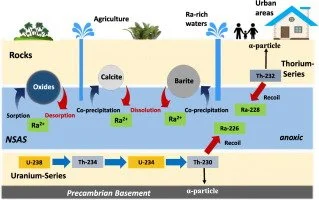
Mahmoud Sherif et. al. 2018, Geological and hydrogeochemical controls on radium isotopes in groundwater of the Sinai Peninsula, Egypt, Science of the Total Environment
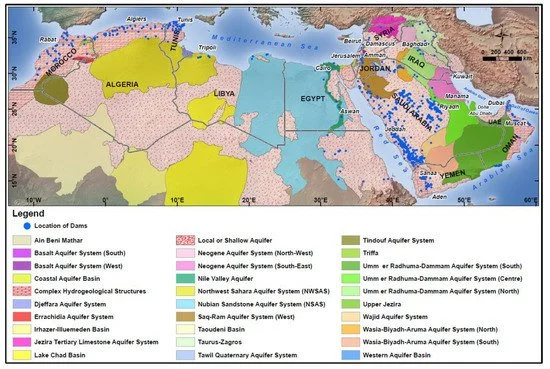
Mohsen Sherif, 2023, A Review of Managed Aquifer Recharge Potential in the Middle East and North Africa Region with Examples from the Kingdom of Saudi Arabia and the United Arab Emirates, Water 15(4), 742; https://doi.org/10.3390/w15040742