
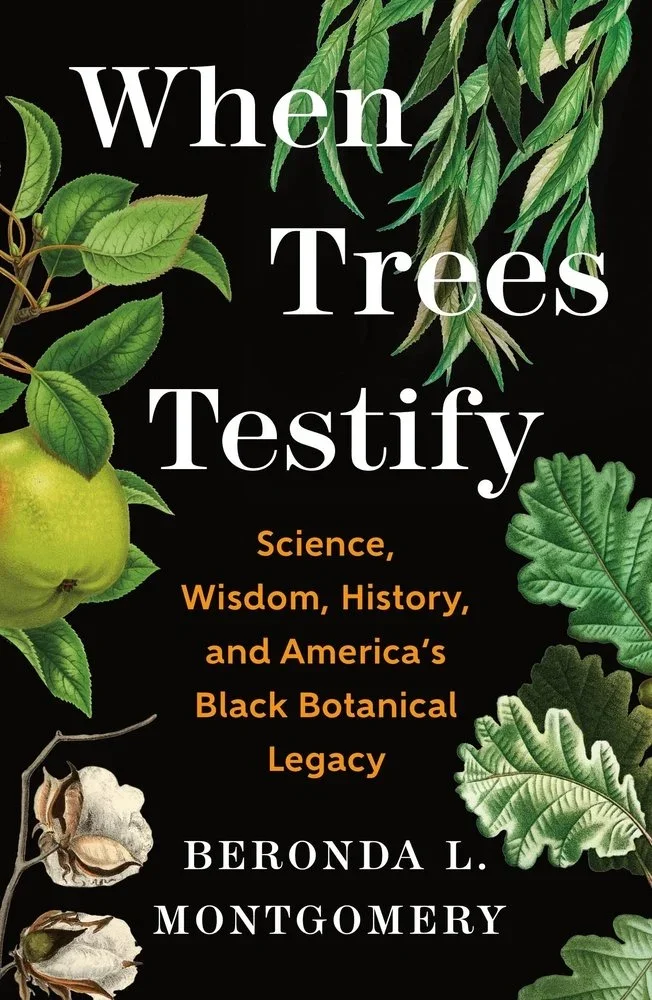
Grateful is the word that comes to my mind after reading Dr. Beronda Montgomery’s new book When Trees Testify: Science, Wisdom, History, and America’s Black Botanical Legacy. I’m grateful to the author for sharing her personal family history, professional experiences, and many tragic and triumphant historical events that cry for awareness, transparency, and reconciliation.
I found this book at the library on the new book section and felt intrigued to learn more about trees. Prior to reading this book, I considered slavery or even more generally farming as requiring mostly physical labor such as during planting and harvesting. I’ve not been aware of the essential agricultural knowledge and skills possessed and shared by African people that transformed the North American landscape into a modern productive agribusiness.
The author provides insightful personal experiences with her upbringing, family history, and an enthusiasm of connecting to trees both scientifically and spiritually. In stark contrast are the numerous examples of the horrible African American experiences of captivity, slavery, lynchings, race riots, massacres, economic and social injustice and more tragic events. How have trees been a witness to these events? Please read the book and here are a few notes that I took with plans to visit some of these or related locations in the future:
Page 6. ‘Pecans hold a deep cultural significance to Black Americans which were domesticated by an enslaved man named Antoine on a plantation in Louisiana around 1846. He successfully grafted 125 pecan trees demonstrating techniques that enabled development of a multi-million dollar industry.’
Page 35. ‘Dr. Dorceta Taylor, an environmental sociology professor at Yale University, shares how freedom fighters like Harriet Tubman possessed extensive knowledge about trees and forests that aided in navigating the outdoors. For example, moss typically grows healthiest on the shaded north side of trees.’
Page 37. “Like other trees, sycamores were used as hanging trees for taking the lives of African Americans.”
Page 41. “In 2014, a sycamore was planted on the grounds of the US Capitol - the Emmett Till Memorial Tree, planted in tribute to the fourteen year-old boy whose murder brought a national focus to the civil rights cause.”
Page 51. ‘Willows prefer growing in waterlogged soils with roots that filter compounds like nitrogen contributing to water purification. Willow bark is well know for medical uses.’
Page 97. ‘ Tulip poplar trees are found at many historical sites including Jefferson’s Monticello and Guilford College (see my previous blog on the Guilford Woods).’
Page 103-104. “A famous poplar dating back to pre-1800, the Underground Railroad Tree in Guilford County, North Carolina, served as a literal witness to acts of self-liberation and proverbial symbol of freedom…In this area where Quakers and free Black Americans resided, self-liberating African Americans sought refuge near this tree, hiding among the trees around the storied poplar. In this haven, the community of Quakers and freed Black people often brought them food or supplies until they could move further on their journey towards freedom.”
Dr. Montgomery states the yellow-flowering tulip poplar, like we planted in our yard (see blog), is actually a member of the magnolia family which both have similar rough, gray bark.
She cites evidence of trees collecting and responding to memories of biological events. In The Power of Trees, Peter Wohlleben documents changing epigenetics of a 330-year old poplar tree by comparing older and younger branches. Trees can communicate, share memories and adjust for environmental changes like climate variations.
Page 115. ‘Plantations like at Monticello, Virginia grew rows of mulberry trees for shade and silkworm cultivation.’
Page 140. ‘In 1861, a free Black woman named Mary Peake began providing lessons to African Americans under the expansive branches of a 200-year old oak tree at a site that eventually became Hampton University.’
Page 178. “Both of my parents labored in the Arkansas Delta cotton fields, although their parents took different approaches to their involvement. My mother had greater trauma related to her many years of being pulled from her beloved schooling to labor for the economic benefit - or at least the basic sustenance - of her family.”
Page 202. “President Jefferson had prized apple orchards at his Monticello plantation that depended upon the care and cultivation of the people he enslaved.” Forbidden to consume apples while enslaved, growing and eating apples became a symbol of freedom as depicted in the children’s book An Apple for Harriett Tubman. Dr. Montgomery states Tubman planted apples and other fruit trees after she escaped from the eastern shore of Maryland traveling on the Underground Railroad to Auburn, New York.
Page 277. “I have drawn on history, family, and inspiration from nature as I attempted to unearth personal victory in When Trees Testify…It is an honor to hear and bear their testimonies.”
Rarely can we find books written by scientists about nature and history that are critical for our understanding of our place in the world today. Reading When Trees Testify gives me a greater appreciation and gratitude for all the sacrifices and wisdom provided by African Americans who proliferated nature’s abundance to feed, clothe, educate, shelter, and sustain people of all origins.