
The new year 2026 will bring important opportunities for us to speak about the proposed data center including AI as discussed in my previous blogs, what’s on the horizon, chronicalling the development project last year and my interaction with a silicon child.
Here’s the first of my planned three minute speeches to the Apex Town Council to be given on January 13- please drop me a comment if you would like to make any suggestions. What follows is a summary of many of our issues, an exchange with the town planner, my draft speech three peer-reviewed articles and data center taking points developed from the Protect Wake County Coalition.
Potential impacts include:
Power needs: Proposed 300 MW data center demand is about triple the amount used by the Town of Apex and equivalent to 33% of Sharon Harris NPP. Backup diesel generators create significant impacts to air, noise, and potential soil and water pollution.
Air, Light, Noise, Sediment-Water Pollution: NOx and PM2.5 emissions from backup diesel generators, bright lights emitted at night from tall buildings, humming noise up to 55 dB, and contamination of surface and groundwater due to construction and increased sediment erosion potentially contaminating drinking water supply wells.
Water: Potable and reclaimed sewage water proposed impacts water supply
Consumption of millions of gallons per day of discharge water from sewage water treatment plant used for cooling and significant loss due to evaporation.
Heat island from sunlight reflected from pavement and buildings instead of absorbed by native vegetation increases daytime temperatures to local residents
Loss of aesthetic view replaced with view of data center towering twice as high above treetops
Loss of agricultural lands and once rural area becomes heavy industrialized-residential area
Increased potential for flooding due to urban development as we’ve seen in Apex washing out Olive Chapel Road and increased severe weather events due to climate change.
Financial issues where residents pay more for utilities and big tech corporations get tax breaks.
I sent an email to the town planner Bruce Venable yesterday:
Hello Bruce:
Hope your holidays went well and you're back in action. I'm preparing to speak at next week's 1/13/25 town council meeting as well as listen to the 1/22/25 joint work session. Could you please share an update on the status of the Natelli application including the UDO amendment application and their response to EAB zoning conditions with proposed environmental conditions?
Is there anything else that would help us understand the annexation and rezoning process from residential to light industrial (LI) given the very conceptual information provided so far in the data center application? I heard that much of the specific design requirements might be submitted by the developer if rezoning is granted by the council?
I'm still struggling to understand how a proposed 300 MW data center with 100 diesel generators consuming significant water resources could be considered LI and want to clarify the issue before speaking to the town council. How do you determine or enforce conditional use requirements as stated in the initial application that the design will "minimize environmental impacts and protect..water and air resources, wildlife habitat and other natural resources?" For example, is the Phase I site assessment publically available and have they completed an environmental impacts assessment or would one be required later?
Thanks again!
Bill
Phone call with Bruce Venable, Apex Planning Department on January 8, 2026
I called Bruce to follow up on my email and learned the data center applicant has not resubmitted anything new since last October. They can submit a revision as soon as next month that would address the issues brought up by the planning department and the Environmental Advisory Board. I asked what kinds of facilities would be unacceptable to be classified as light industrial and he used the example of a meat packing plant that would have noise, smell, and other problems. Since there are existing small scale data centers that support cloud computing, scale is the issue now and it is not known how large of a data center would be considered acceptable for light industrial. The developer submitted their application for a hyperscale 300 MW facility before the planning director issued a letter classifying acceptable sizes of data centers. So now the town must consider the application. How should the town council address or evaluate issues presented in the application? Just saying there might be a problem, such as evaporative wastewater mist that could cause legionella disease, it would be better to provide actual scientific evidence elsewhere.
Bruce would like us to send him peer reviewed literature and not news articles. The planning department does not review site reports like Phase I documents that will go into the site file for other department reviews. There will be a public hearing with the planning department in spring or summer and then another public meeting with the town council. Bruce is coordinating with other towns and states to see about developing consistent standards and best practices. He did not see the PWCC information on ordinance recommendations provided to the town council on October 28. We discussed the evolving technology and how AI and gen AI are disruptors and there could be an AI investment bubble bursting soon as well as new space-based data centers in the future.
Updated Draft speech to Town Council for January 13, 2026
My name is Bill Dam and I live at…
Our area and big tech continue to experience explosive growth so we hope -- as you evaluate the hyper-scale data center application, you’re considering the strengths, weaknesses, opportunities and threats known as a SWOT analysis. My environmental science career includes working on nuclear issues so I’m not surprised that artificial intelligence is being compared to the Manhattan Project made famous in the Oppenheimer movie showing the RUSH to build and use atomic weapons.
I have a neighbor in Jordan Manors who grew up downwind from above ground nuclear testing; he told me that many of his classmates contracted and died from leukemia attributable to atomic testing. There will be also be fallout with AI and do you want all of us to be living in ground-zero? Weapons and machines don’t love us, but we love getting to know our neighbors.
Not only is the arms race similar but consider the ransomware cyber-attack on the Town of Apex utility causing billing problems which must have gone through an existing data center. Have you heard about new vulnerabilities like AI zero click bots? Who loves deepfake videos, junk email and texts, boom and bust cycles, and the Merriam-Webster 2025 word of the year “slop” defined as low-quality, mass-produced digital content? Tragically, many people including a 16-year old boy in Southern California committed suicide with the help and encouragement of an AI chatbot. OpenAI released data in late 2025 indicating that more than a million people a week discuss suicide with ChatGPT (TheGuardian).
Proposed AI data centers with enormous appetites are proliferating around the country including here in Apex which in my opinion as a non-lawyer violates federal laws such as the National Environmental Policy Act. Is building an AI data center worth trading for our precious resources including air, energy, money, soil and water? We trust you the town council will abide by laws and moral values including the principle of Love thy Neighbor:
· We look to the board to protect our families, neighbors and the health and safety of our community.
· Our children and grandchildren should not have to breathe pollution from diesel generators or burning fossil fuels increasing risk of asthma and cancer.
· Our pets and wildlife should not be subjected to a harmful environment, including noise 24/7, but the developer’s consultant is only looking at noise levels impacting less sensitive human hearing.
· We care for our landscaping, but droughts and data center demands could kill our vegetation and reflected sunlight can create a heat island increasing local temperatures.
You’ve asked us what types of buildings we might find acceptable for light industrial rezoning and we’ve given examples like retail or medical supply. I wonder what you would find unacceptable to put next to 6000 residents and near Apex Friendship schools. Would you also consider applications for nuclear waste storage, an oil refinery, a meat-packing plant or a fireworks warehouse as well as a 300 MW data center?
We hope during the January 22 joint session with the planning department you will carefully evaluate SWOT cost-benefits for a hyper-scale digital campus and you’ll agree with us that it does not fit the town’s future vision for light industrial. The choice is clear. Thank you!
Updated January 13, 2026
In response to the town planner’s request for peer reviewed literature, here are three articles from universities using Google Scholar.
Eco-Environment & Health, v.4, issue 3, Sept. 2025, Authors Yu Tao a, Peng Gao b
a School of Eco-Environment, Harbin Institute of Technology, Shenzhen 518055, China
b Department of Environmental Health, Harvard T.H. Chan School of Public Health, Boston, MA 02115, USA
“Data centers (Fig. 1) —the backbone of the digital economy—are rapidly expanding globally to meet surging demand, yet this growth brings underappreciated risks to human health. They consumed 1.5% of global electricity in 2024 and are expected to represent nearly 10% of the electricity demand growth from 2024 to 2030 [1]. Despite efforts to curb their carbon and water footprints, the public health implications of data center expansion remain largely overlooked.
Data centers generate significant noise pollution primarily from diesel generators and Heating, Ventilation, and Air Conditioning (HVAC) systems, with internal noise levels reaching up to 96 A-weighted decibels (dBA)—well above the 85 dBA threshold considered harmful to hearing [2]. This persistent noise adversely affects data center staff, nearby communities, and local wildlife, prompting increased public concern and a push for noise mitigation strategies.
Air pollution is the most acute concern. Fossil-fueled power plants and diesel backup generators that power data centers emit hazardous pollutants such as nitrogen oxidesand fine particulate matter, increasing rates of respiratory diseases, cardiovascular conditions, and elevating cancer risk in nearby communities. A recent model indicates that the U.S. data centers in 2030 could contribute to nearly 1300 deaths annually, resulting in a public health burden of more than $20 billion [3].
Moreover, significant water needs for cooling, often from drinking supplies, create additional challenges. In certain areas, data centers consume up to 57% of cooling water from potable sources [4], worsening water scarcity in stressed regions. A typical hyperscale data center can use 3–7 million gallons of water per day for cooling purposes. Such consumption exacerbates local water insecurity, increasing the risk of waterborne diseases, dehydration, and poor hygiene in affected communities.
To protect communities, policymakers and industry must proactively mitigate these health risks. Key strategies include: (i) Power data centers with renewable sources and replace diesel generators with battery storage or fuel cells to eliminate exhaust emissions. (ii) Use advanced cooling technologies to reduce water use and recycle waste heat, alleviating local water scarcity and enhancing energy efficiency. (iii) Mandate public reporting of data center pollution. Greater transparency and stricter standards would hold operators accountable and encourage cleaner practices. (iv) Position new data centers away from populated or polluted areas and choose cleaner, low-density sites for energy-intensive workloads to reduce human exposure.
Empirical research is urgently needed to inform policy. Little is known about long-term health outcomes in data center host communities. Interdisciplinary studies should quantify pollution exposures (air, water, noise) and track associated health effects. Life-cycle assessments of data centers—from power generation to hardware disposal—can identify critical emission sources. Such evidence is vital to ensure that the digital revolution does not come at the expense of public health.
In summary, the global data center boom is emerging as a public health concern. Proactive mitigation and targeted research are imperative to safeguard public health while sustaining digital innovation.”
2. Hitchcock, I., and M. Cahoon. 2025. Hyperscaler Data Center Buildout: A Sustainability Bane, Boon, or Both? NI R 25-04. Durham, NC: Nicholas Institute for Energy, Environment & Sustainability, Duke University. https://nicholasinstitute.duke.edu/publications/hyperscaler-data-center-buildout-sustainability-bane-boon-or-both.
“Hyperscalers are large-scale cloud computing providers that operate massive data centers to support global digital services. The rapid expansion of hyperscale data centers is driven by increasing demand for cloud computing, artificial intelligence, big data analytics, and digital transformation across industry and government. These data centers can provide services such as computing and storage at enterprise scale but consume large amounts of energy and water to do so, posing sustainability challenges. This report surveys sustainability concerns related to digital infrastructure expansion and identifies areas where collaborative, pragmatic policy and technological solutions can help address them.”
3. Adam Zewe, Explained: Generative AI’s environmental impact, MIT News, January 17, 2025 https://news.mit.edu/2025/explained-generative-ai-environmental-impact-0117
Rapid development and deployment of powerful generative AI models comes with environmental consequences, including increased electricity demand and water consumption.
“What is different about generative AI is the power density it requires. Fundamentally, it is just computing, but a generative AI training cluster might consume seven or eight times more energy than a typical computing workload,” says Noman Bashir, lead author of the impact paper, who is a Computing and Climate Impact Fellow at MIT Climate and Sustainability Consortium (MCSC) and a postdoc in the Computer Science and Artificial Intelligence Laboratory (CSAIL). “The demand for new data centers cannot be met in a sustainable way. The pace at which companies are building new data centers means the bulk of the electricity to power them must come from fossil fuel-based power plants,” says Bashir.
Each time a model is used, perhaps by an individual asking ChatGPT to summarize an email, the computing hardware that performs those operations consumes energy. Researchers have estimated that a ChatGPT query consumes about five times more electricity than a simple web search.
“But an everyday user doesn’t think too much about that,” says Bashir. “The ease-of-use of generative AI interfaces and the lack of information about the environmental impacts of my actions means that, as a user, I don’t have much incentive to cut back on my use of generative AI.”
Chilled water is used to cool a data center by absorbing heat from computing equipment. It has been estimated that, for each kilowatt hour of energy a data center consumes, it would need two liters of water for cooling, says Bashir.
“Just because this is called ‘cloud computing’ doesn’t mean the hardware lives in the cloud. Data centers are present in our physical world, and because of their water usage they have direct and indirect implications for biodiversity,” he says.
“The industry is on an unsustainable path, but there are ways to encourage responsible development of generative AI that supports environmental objectives,” Bashir says.
We provided an updated list for the Apex Town Council:
Data Center Ordinance Talking Points
Volunteer-Friendly Guide for Community Use
(Proposed 300 MW Data Center Project, New Hill NC)
Core Message (Use This First)
Data centers can bring tax revenue, but they also bring round-the-clock noise, industrial generators, heavy water use, air pollution, fire risk, and permanent land impacts.
If our town or county allows one, it must come with clear rules, strong limits, constant monitoring, real penalties, and financial guarantees — so residents don’t pay the price.
1. Clear Definitions & Size Limits
Talking Point:
We need a clear legal definition of what a data center is — and how big is too big.
Why it matters:
Without clear size categories, developers can exploit loopholes and build much larger facilities than residents expect.
What we’re asking for:
Clear size categories (small / medium / large)
Anything very large must require special approval and public review
Bigger buildings = stronger rules and setbacks
2. Noise: Studies, Limits & Real Enforcement
Talking Point:
Data centers are not quiet. Fans and backup generators run day and night.
Why it matters:
Low-frequency noise travels far, penetrates homes, disrupts sleep, and affects health.
What we’re asking for:
Noise studies before approval and after construction
Clear limits, especially at night
No exemptions for routine generator use
Town-owned noise monitors running 24/7
Noise data must be public
Serious fines if limits are exceeded — escalating if violations continue
3. Lighting & Night-Sky Protection
Talking Point:
Residents should not live next to an industrial light dome.
Why it matters:
Bright, constant lighting harms sleep, wildlife, and rural character.
What we’re asking for:
Near-zero light at residential property lines
Full cut-off, downward-facing lights only
No lights close to homes or parks
Lighting plans reviewed and approved before construction
4. Setbacks & Buffers From Homes
Talking Point:
Distance is one of the best protections.
Why it matters:
More space reduces noise, light, visual impact, and health risks.
What we’re asking for:
Large setbacks from property lines
Even larger buffers from existing homes
Equipment placed far away or fully screened
5. Building Size, Height & Appearance
Talking Point:
These buildings should not look like concrete bunkers.
Why it matters:
Massive blank walls hurt property values and community character.
What we’re asking for:
Height limits that include rooftop equipment
Maximum building footprints
Architectural standards that break up long walls
No cheap industrial siding
Full architectural drawings reviewed by the town
6. Diesel Generators: Emissions, Testing & Timing
Talking Point:
Backup generators are major pollution sources, not minor details.
Why it matters:
Generators emit nitrogen oxides, particulates, and other harmful pollutants — even during “testing.”
What we’re asking for:
Cleanest possible engines and fuels
Generator testing only during limited daytime hours
Quiet enclosures
Annual emissions testing
Fuel spill containment
Developer must fund fire protection upgrades if needed
7. Battery Storage & Fire Risk
Talking Point:
Lithium-ion battery fires are extremely dangerous and hard to control.
Why it matters:
Many local fire departments lack equipment and training for battery fires.
What we’re asking for:
No lithium-ion batteries unless fire officials explicitly approve
Detailed fire-mitigation plans
Extra financial assurance if risky systems are used
8. Water Use & Groundwater Protection
Talking Point:
Our water should not be sacrificed for servers.
Why it matters:
Data centers can strain water systems and contaminate groundwater.
What we’re asking for:
No new private wells for potable water
No potable water for cooling
Independent groundwater studies
Monitoring of nearby wells
Developer pays for all water infrastructure upgrades
Stormwater systems sized for extreme storms
9. Cooling Systems & Chemicals
Talking Point:
Cooling systems use chemicals that can affect air and water.
Why it matters:
Evaporated chemicals can end up in the air and nearby land.
What we’re asking for:
Closed-loop or recycled water systems
Strict chemical controls
Monitoring and penalties for unpermitted releases
10. Renewable Energy Requirements
Talking Point:
If data centers consume massive power, they should also help produce clean energy.
Why it matters:
These facilities strain the grid and increase emissions.
What we’re asking for:
A required percentage of power from renewables
Cleaner fuels for backup generators whenever possible
11. Independent Technical Studies
Talking Point:
We shouldn’t rely only on the developer’s numbers.
Why it matters:
Independent modeling shows real impacts — not marketing claims.
What we’re asking for:
Lifecycle carbon analysis
Air pollution modeling
Health risk modeling
Peer review by third-party experts
12. Taxes & Incentives
Talking Point:
Don’t give away public money without proven public benefit.
Why it matters:
Data centers often already receive state incentives.
What we’re asking for:
No local tax breaks unless benefits are proven
Any incentives tied to enforceable community commitments
13. Decommissioning & Cleanup Bonds
Talking Point:
If the data center closes, taxpayers should not be stuck with the cleanup.
Why it matters:
These buildings are expensive to demolish and may be contaminated.
What we’re asking for:
A large bond or escrow fund
A clear decommissioning plan
Environmental cleanup guaranteed by the developer
14. Full Environmental Impact Review
Talking Point:
Projects of this size deserve full transparency.
Why it matters:
Noise, air, water, traffic, and emergency services are all affected.
What we’re asking for:
A full Environmental Impact Statement
Public hearings
Independent review of technical reports
No permits until review is complete
15. Independent Cost–Benefit Analysis
Talking Point:
We need to know if this actually benefits the community.
Why it matters:
Tax revenue can be outweighed by infrastructure, health, and service costs.
What we’re asking for:
Independent study paid for by the developer
Real accounting of costs and benefits
Peer review of developer claims
16. Utilities & Annexation Protections
Talking Point:
Residents shouldn’t subsidize private infrastructure.
Why it matters:
Data centers often require major utility upgrades.
What we’re asking for:
Developer pays for all utility upgrades
Clear ownership of substations and infrastructure
Easements granted to the town on town terms
Bottom Line
If a data center is coming, it must follow strict rules, pay its own way, protect residents, and remain accountable for decades — not just during approval.
Updated January 14, 2026
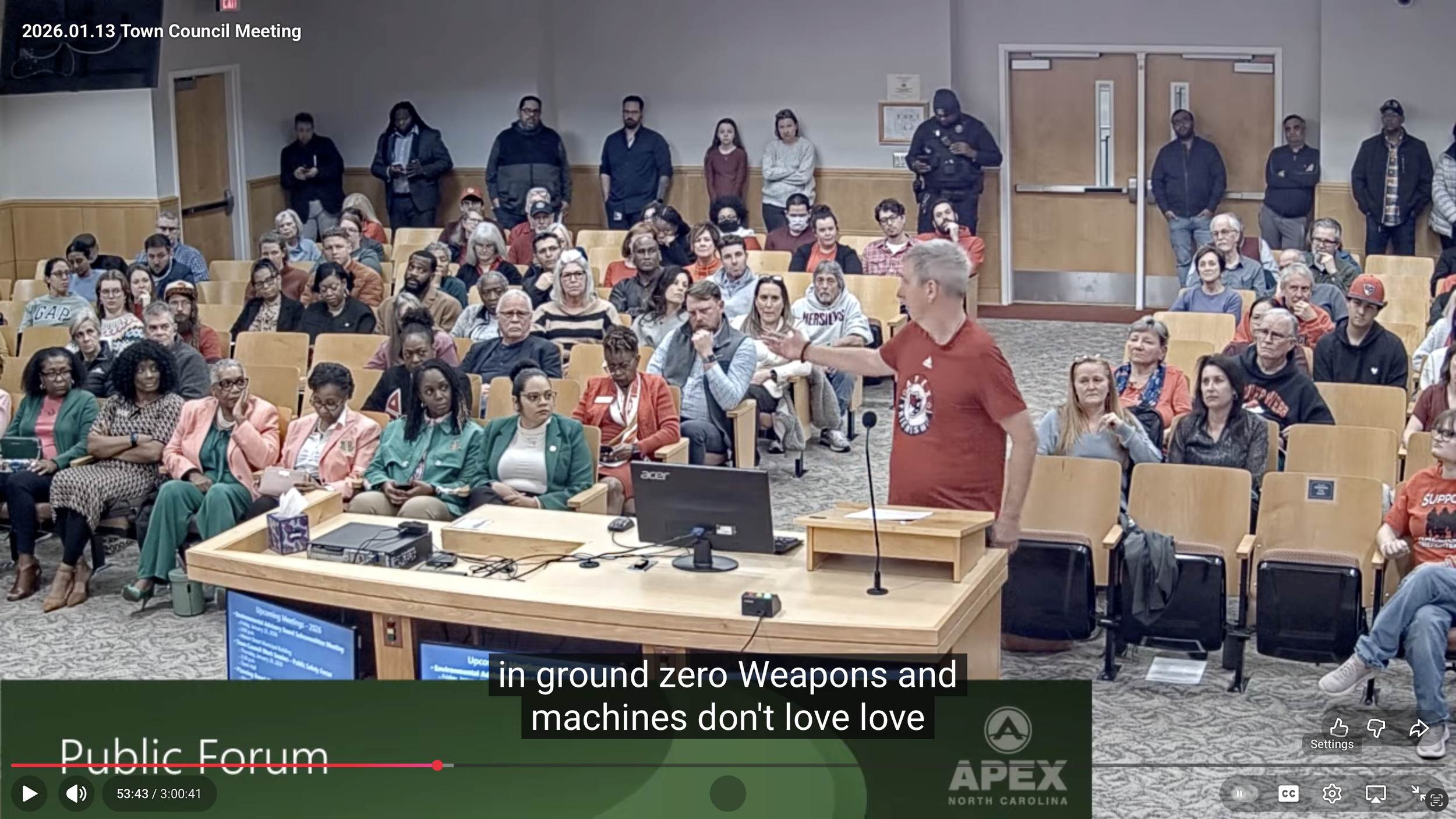
The Town of Apex Council meeting held last night brought out a packed house! Roughly half of the audience came out wearing red to stop the data center application. Here is the YouTube video starting at minute 42 with the following presentations:
Melissa Ripper: spoke with her children about the huge evacuation from the October 2006 chemical fire at a hazardous waste transfer facility. Here’s a retrospective CBS-17 article on the explosion and fire.
Michelle Hoffner O’Connor: spoke about her research on noise and sound measurements conflicting with misrepresentations by the developer’s consultant.
Lorriane McCoy-Mowl: lives in Chatham county as a New Hill resident said the developer neglects to show a site plan beyond a few buildings and is not showing the magnitude of what an industrial site would look like.
Bill Dam: I provided the speech as shown above in this blog starting at minute 52.30.
Rosemary Sanozky-Dawes: lives in Fuquay-Varina town of Wake County shared her concerns for depleting water from the Cape Fear River basin as well as challenging the town’s interactions with the developer.
Glenn Rinne: shared his investigating big tech firms methods of tax and risk avoidance strategies to fund capital investments for data centers.
Dawn Cozzolino: described lack of public benefits by big corps, eminent domain, and lack of oversight.
Fran Hudson: developer should not have input into the town UDO laws which are not policies and she sent letters. The energy use by the proposed data center is larger than the power usage by the town of Cary.
Christine Campbell: spoke about ProtectWakeCountyCoalition shared our ordinance points as shown above.
Barbara Collins: 28-years loving Apex and reminded council they know everything to say No to data center.
The public forum concluded as shown on the YouTube video at 1:20 (hour:minutes).
Updated February 24, 2026
Here’s a new testimony that I’m planning to give tonight:
Good evening Mr. Mayor and Town Council members and staff:
My name is --- and I live at ---
Seven weeks ago, I spoke in opposition to the proposed hyperscale data center - the so-called “digital campus” located just two miles from my home. Since then, there have been countless discussions on social media and in formal and informal meetings, set there’s no central place where the public can follow the official records. Why hasn’t the town created a single website for this application? And are social media posts considered official public records?
The Apex Interactive Zoning Map shows the most recent update for the application happened in September 2025 showing the Environmental Advisory Board (EAB) suggesting voluntary zoning conditions — without any public comment. The EAB has since changed its rules to allow public input, which raises an obvious question: why did they rush to a vote before that change? We’d ask the Town Council to consider a joint meeting with the EAB as you’ve recently done with the Planning Board and Department.
On the financial side - where is the data? We keep asking for a cost-benefit analysis showing project tax revenues, how long those revenues would last, and what the real costs to the town would be. We want to see the numbers, not just promises.
(THAT IS AS FAR AS I READ AND SEE UPDATE BELOW FOR MORE.)
We’ve also heard reports that the big tech firms demand non-disclosure agreements to be signed. If an NDA exists, it needs to go into the public record. And critically - does that NDA require the destruction of public records that could conflict with public records laws?
Finally, we still don’t know who this data center is actually being built for. If we know the end user, we could make informed comparisons to similar projects and their real-world impacts. The public deserves to know!
To summarize what we’re asking for:
an independent, third-party study with no connection to the project covering both the environmental and fiscal impacts
full disclosure of any NDAs
public identification of the unnamed company
a commitment that any vote on the UDO will be held separately from the vote on the Natelli application - rushing those together would shortchange the process and the public.
Thank you!
Extra info prepared but not planned to be presented in the three minutes allowed:
Last time I expressed concerns praying that you put people in front of high tech profits and property tax revenues; that we love our families and neighbors but technology like AI data centers will never love us back. In the wrong hands, these tools can be very harmful to people and nations. However, it’s heartwarming to see the youthful speakers tonight, including at least one pregnant mother, who are inheriting our legacy and depending on you to act in their best current and multi-generational interest.
I did not mention how upsetting this process is for the community and how much time we are spending pro bono trying to prevent a predictable disaster impacting our property, our lives, our pets, our wildlife for the town, the state and the nation. Ben Frankin, a founding father, said "If you fail to plan, you are planning to fail."So where is the national, statewide or local environmental impact statements including the socioeconomic impact analysis required by the National Environmental Policy Act? Oh, federal laws apparently are getting bypassed by executive orders. Once you rezone from residential to light industrial there is no going back.
What standards do the Town of Apex employees, board members and Council hold themselves to for protecting our public health, safety and the environment? Are you avoiding the appearance or actual conflicts of interest with high tech company developers? Are you making your financial income, stock ownership, and other disclosures available to the public? Will participation in this review look good on your resume at your job?
Given all the uncertainties and unknowns, we are asking you not to rezone the land from residential to light industrial that could include permitting a 300 megawatt heavy industrial hyperscale data center. We care about the process being done with transparency and accountability.
Did anyone involved with this project representing the town sign a non-disclosure agreement NDA and have private meetings with the developer that have not been disclosed to the public? Does the NDA require records to be destroyed that violates other laws?
Can you tell us now who will the digital campus be built for? If we knew that, we could make reasonable comparisons to similar builds and impacts?
We need to spend much more time discussing the numerous benefits of the current agricultural lands as well as potential environmental impacts during proposed construction and operations as well as the public participation process in our representative democracy to ensure transparency and accountability.
I would like to respond to many of the technical discussions presented by the Planning and Water Departments lasting over four hours (or 240 minutes) on January 22nd. But I cannot do that in 3 minutes and no time for public comments was provided during the joint sessions with planning, water, fire, police and other departments.
From Adam Whitaker with The Peak Weekly documented that the Town Manager Mr. Vosburg signed a non-disclosure agreement is identical to one signed with Amazon. I will be asking in writing to each member involved if anyone else signed an NDA. We probably won’t read about that in the Washington Post which is owned by Amazon owner Jeff Bezos.
Here are some of the things we want:
An independent study provided by a third-party with no connect to the project to include the environmental and fiscal impacts.
Put any NDAs into the public record. I understand that under N.C.G.S. § 132-1, these NDAs are public records and other towns do share these.
We demand to know who "The Company" is. If the Town Manager signed an NDA with an unnamed party, we have a right to know who our government is entering legal agreements with. The identity of a party to a government contract is not confidential information - it's the most basic element of public accountability.
Ask your Council Members directly: did you sign an NDA and what one-on-one meetings have you had with Natelli or Amazon? Not at a public hearing where they don't respond. In writing. By email. On social media where they can't ignore it. Amazon's documented practice in Warrenton and Orange County was to individually brief every member of the governing body under NDA. Ask each Apex Council Member, by name, whether they signed one and if they have met with them by themselves. Their answers - or their refusal to answer - will tell you everything.
Demand that the UDO vote and Natelli vote do not happen one after the other. There is absolutely no reason to put these two votes together other than to rush the Natelli vote through before anyone even has a chance to digest the UDO changes.
Update February 25, 2026
Just before the meeting presentations yesterday, I asked for feedback on my draft talk and got some good responses including from Adam Whitaker:
“ think this is excellent. I think you have hit on the main points. Despite my somewhat lengthy email below, I don't really think you necessarily need to change anything. But I'll give you some thoughts just for the sake of brainstorming. Throwing this together quickly and it’s a big all over the place but if you find something in here useful, feel free to use it!
1. First paragraph is a fantastic point. We, the public, got to see a presentation and some UDO recommendations. But the next time we'll see them is during the vote, moments before the data center vote? Love the idea of a website that updates us and being transparent with the process that occurs between that presentation and the official vote. Also, I know the last question is probably rhetorical, but 100% absolutely their social posts are public record. In a recent work session, I think the one where part 2 of the data presentation was made, they discussed this topic and left with homework to create some sort of policy that defines what is public record or not in terms of town official's use of social media. But that's insane. NCGS § 132-1 defines this already. The Town of Apex cannot decide what is public record or not. If a town official is conducting official business, it's public record. Period. Doesn't matter where it's at, what disclaimers exist, etc. I think that Elizabeth Stitt is actually going to talk to this specifically during public forum tonight.
2. Natelli website's own FAQ. Probably not worth mentioning, but their project website confirms that they "eventually either lease or transfer the property" to unnamed companies." They are admitting to the shell structure in their own marketing materials. Maybe this is used as leverage for the question - who is that unnamed company?
3. The Independent Study. Ties in with #1 but I think that everyone should really lean into this. Once "Data Storage Facility" is defined and regulated in the zoning code, it becomes a legitimate by-right use. If a developer checks the boxes, the town essentially loses its ability to deny. The UDO isn't just a procedural step; it's the mechanism that makes future data centers nearly automatic. Even if you ignore the fact that Randy lead the project while under NDA with the end user, not bringing in a third party expert to do this is unacceptable.
4. For the "things we want" at the end:
"Put any NDAs into the public record". Maybe add on to be specific... "that includes any potential NDAs signed by Town Council Members, Mayor, Economic Development Staff, staff involved in the data center research, etc..."
"Who approved the Town Manager signing the NDA?" Could be a good question. Did he do it himself, did the Attorney sign off, did council sign off?
"Have any records been destroyed already?" A bit speculative but he did sign a contract saying he would do that if they asked. So what has been destroyed so far? How would we ever know?
Despite the evidence, people can still argue about whether or not its actually amazon, whether or not NDAs are normal. But I dont know how anybody can argue that its acceptable to sign an NDA with anybody that has language about destroying records or attempting to maintain anonymity while simultaneously acknowledging they arent able to do that.
Here's a write up that I put together that more clearly than my notes above pulls together the issue of signing that NDA. Feel free to steal this, alter this, or anything else:
"Under North Carolina General Statute 132-1, the NDA the Town Manager signed is itself a public record. And the identity of the parties to a government contract is the most basic element of public accountability - it's not confidential. But in this NDA, they used the phrase 'The Company' instead of naming who our government entered into a legal agreement with. They structured the document to hide the one thing the law says we have a right to know. And here's what makes it worse - the NDA contains its own language acknowledging the identity is subject to public records law. Whether it's about the data center - or anything else for that matter - we have a document that admits it can't override our right to this information, while being deliberately written to do exactly that. Any reasonable person analyzing this would conclude that it was done with the intent that the public would never find it. WHY?"
I do plan to be at the next council meeting. My gut feeling is that the discovery of this NDA (and Amazon) is going to blow this whole project up and, if I'm right, then I'm preparing to take on the conversation that we can't just let all of this stuff go; we still need to talk about the NDA, what happened with that research, what closed door meetings happened, who else signed an NDA. Our town reps operating in secret like this can't happen again.
Good luck and thank you so much for taking a stand and having the courage to get up and speak.
Adam Whitaker | Publisher, www.ThePeakWeekly.com
About 10 minutes into the meeting I got a text message from a friend in the audience who said: “Don’t discuss Adam’s news about the NDA so we can wait and discuss for making a more powerful impact and not to show all our cards yet.”
At the Apex Town Hall Meeting last evening, starting at minute 17, the Mayor Pro Tem Terry Mahaffey stated: he’s the council board representative for the Environmental Advisory Board for a couple of past meetings and wants to get the EAB more active and involved in decision making so a second hearing as part of the applicant is needed to make recommendations and for the EAP to vote on merits of proposal and having discussions.
However, it was not exactly clear which application he referred to so I made that a point in my presentation. The public forum began at about minute 28 with the following speakers relevant to the data center:
Dawn Cozzolino: sang and advocated for transparency in decision making by sharing development options before council votes, long delays in obtaining public records, need to increase public participation, and upholding our constitutional rights for We the People!
Elizabeth Ray Stitt: cited need for a social media policy for town council members posting as officials or unofficial acts. She submitted a records request but only obtained the state policy that did not resolve the issue.
Michelle Hoffner O’Connor: shared a personal story of how carbon monoxide from indoor space heaters can impact prenatal fetus health. Similarly, the data center would cause harms that we cannot allow.
Sarah Arunachalam: shared Part 2 of his testimony on air quality. See the speech on my blog here.
Bill Dam: I shared the first part of my written speech stated above. With some more time, I shared my personal story about growing up with asthma. See minute 47 for my talk on the YouTube Video.
Barbara Collins: said, “some people are talking without listening in a world where silence is given, not chosen, so I’m going to stand here so you can feel the pressure of being silent. The people will not be silenced” then she sang a lyric from the Simon and Garfunkel The Sounds of Silence.
Doug Rouse shared his opposition to the New Hill data center based on looking back at the October 2006 chemical fire at a hazardous waste transfer facility CBS-17 article. About 17,000 people needed to evacuate the area and many suffered health impacts. He also mentioned the United Nations alert on the Global Water Bankruptcy so he does not support a data center’s consumption of one million gallons of water per day.