
Growing up in the 1960’s in the suburban Washington, DC area, I suffered from asthma so there were days and nights when I thought I might be taking my last painfully wheezing breath. Certainly sucking in pollution did not make my condition better and made me more aware of the importance of clean air. The worst sources of pollution came from people burning leaves, trash, wood stoves, coal-fired power plants, gasoline and diesel fumes from vehicles and industry - all these were legal and common in my area and still are in many parts of the world. I’m one of 300 million people who suffer from asthma and while I’ve learned to control my symptoms, including where I choose to live, many people are not so fortunate.
In June 2019, I wrote a blog that doctors are prescribing clean air for our health and see the disease of toxic pollution getting worse. Over 70 groups signed a call to Climate Health Action.
University professors and government agencies are assisting medical professionals to evaluate the impacts of air pollution effects on human health. Global data sets combining air quality collected from NASA satellite are now available! These maps can help doctors, researchers and environmental justice advocates to evaluate air quality impacts from pollutants including small particles (PM2.5), nitrogen oxides (NOx), volatile organic compounds (VOCs) and ozone (O3).
What happens when a project is proposed and it won’t show up on current global datasets? For that we need to employ computer simulations to create models. This week, a neighbor and colleague shared his modeling predictions to the Apex Town Council on the proposed 300 megawatt data center that is the frequent subject of my blogging to raise awareness. Here’s his testimony:
“Good evening, Mayor Gilbert, members of the Apex Town Council and Town staff: My name is Sarav Arunachalam, a 26-year resident of Apex . I am a Chemical Engineer and Professor of Environmental Sciences and Engineering at UNC Chapel Hill. I am also Director of the Center for Environmental Modeling for Policy Development at the UNC Institute for the Environment.
I have studied emissions and air pollution for the past three decades and worked with multiple state agencies, industry and the U.S. EPA on various air quality issues. I have given expert testimony to the North Carolina Department of Justice, U.S. Department of Justice, and most recently to the U.S. Senate on U.S. methane-related air pollution and health. I am here to talk about the proposed 300 MW Data Center in New Hill, which among other impacts, will have onsite generators with excess emissions of multiple pollutants that will lead to dirty air, contaminated water and unhealthy citizens. Generating power for a 300 MW data center on-site is akin to having a polluting power plant in the town with its motto “Peak of Good Living”.
The state of North Carolina has been in attainment of the health-based standards for all criteria air pollutants for over a decade, except in 2023 when there were exceptional events due to smoke from the Canadian wildfires. When a region achieves all air pollutant standards, the citizens are healthy, millions of $ are saved due to avoided health costs, the economy grows and the skies are blue. However, when a region is designated nonattainment, and if the region/state doesn’t have a plan for emissions reductions to clean the air, various enforcement measures kick in. Besides increased health costs to the general public, the nonattainment region suffers on various fronts. Despite some considerations by the EPA (reported by NYT last month) not to look at savings in health costs for pollution controls per a recent proposal, the fact remains that when you avoid pollution, you save on health costs. With the proposed 300 MW data center in New Hill, we are at the risk of having excess emissions that will likely reverse over a decade of clean air that citizens of North Carolina have enjoyed. It is then likely for Wake County and its neighbors to show up in the dirty county list that the American Lung Association compiles each year.
These excess emissions are projected from both the proposed data center due to onsite generation of backup power, as well as from Duke Energy when Duke has to ramp up production to meet year-round energy demand on the grid including possibly extending the life of fossil-fuel based power plants. Just last week, when we had an invasion of Arctic air into the region, we saw that Duke made an appeal to the citizens of North Carolina to reduce its energy usage to help with increased energy demand. So many hyperscale data centers in other states were required to operate backup emergency diesel generators.
I will switch to a narrative on a tale of two Data Centers. In the first Data Center, the one proposed for New Hill, the onsite backup generators are expected to run for multiple hours over the period of a year for testing, and then for backup power for the Data Center should there be a power outage or emergency from Duke. Using a regulatory dispersion model developed and promulgated by the EPA, I have taken the liberty to model the air quality impacts of excess emissions of oxides of nitrogen (NOx) assuming that they will use diesel fuel.
While the generators can be fueled by any of diesel, natural gas or renewables, we have heard from the developer about the potential use of Tier 4 generators. While a Tier 4 generator is better than Tier 3, the potential still exists for using fossil fuel, and I will use that scenario here. There are two alternatives to having this backup power generation. A single large facility onsite with a tall stack or 100 smaller sources with likely identical capacity. I have provided a series of maps to help you walk through this modeling.
Figure 1 shows the prevailing direction of winds as are reported at the Raleigh-Durham international airport, which is representative for this region. As you will see, for 3 of the 4 seasons, the winds are blowing from the Southwesterly direction. However, during the Fall season, they are from the Northeast. I will show air quality impacts of NOx emissions ( one of the many pollutants emitted during diesel combustion) as footprints using contour plots.

Figure 2 shows incremental rings that are uniformly spaced by 1 km from the proposed facility on Shearon Harris Road. These rings intersect New Hill Olive Chapel Road at 2-km, 540 at 8-km and NC-55 at 11km downwind from the facility. [Note that I am discussing units in SI units, which is the norm mandated by the American Meteorological Society for atmospheric science calculations to promote consistency and standardization for comparison in global context]. I have also shown the locations of the vulnerable and sensitive populations - our children, by identifying locations of multiple schools and playgrounds in Apex. Figure 2 (right panel) also shows the alternate location of these 100 generators – laid out in a 10x10 array on the proposed property for this modeling study.

Figure 3 shows the annual average (on the left) and the single hourly maximum NOx concentrations (on the right) at each receptor at these radial distances. The annual average values are almost 1 µg/m3 at this location where we are right now, i.e., the Apex Town Hall, while the maximum single hour concentration exceeds 200 µg/m3 just outside the 1-km ring. We also see values of > 50 µg/m3 near the Apex Town Hall, over 11-km away from the facility.

Now, let us look at an alternate scenario where the proposed facility will have 100 smaller capacity (3MW) generators as is being proposed. Since these are much smaller in size, it is reasonable to assume that the emissions release height is lower than a single tall facility and hence the atmospheric dispersion will be relatively localized, i.e., higher impacts in the near-field.
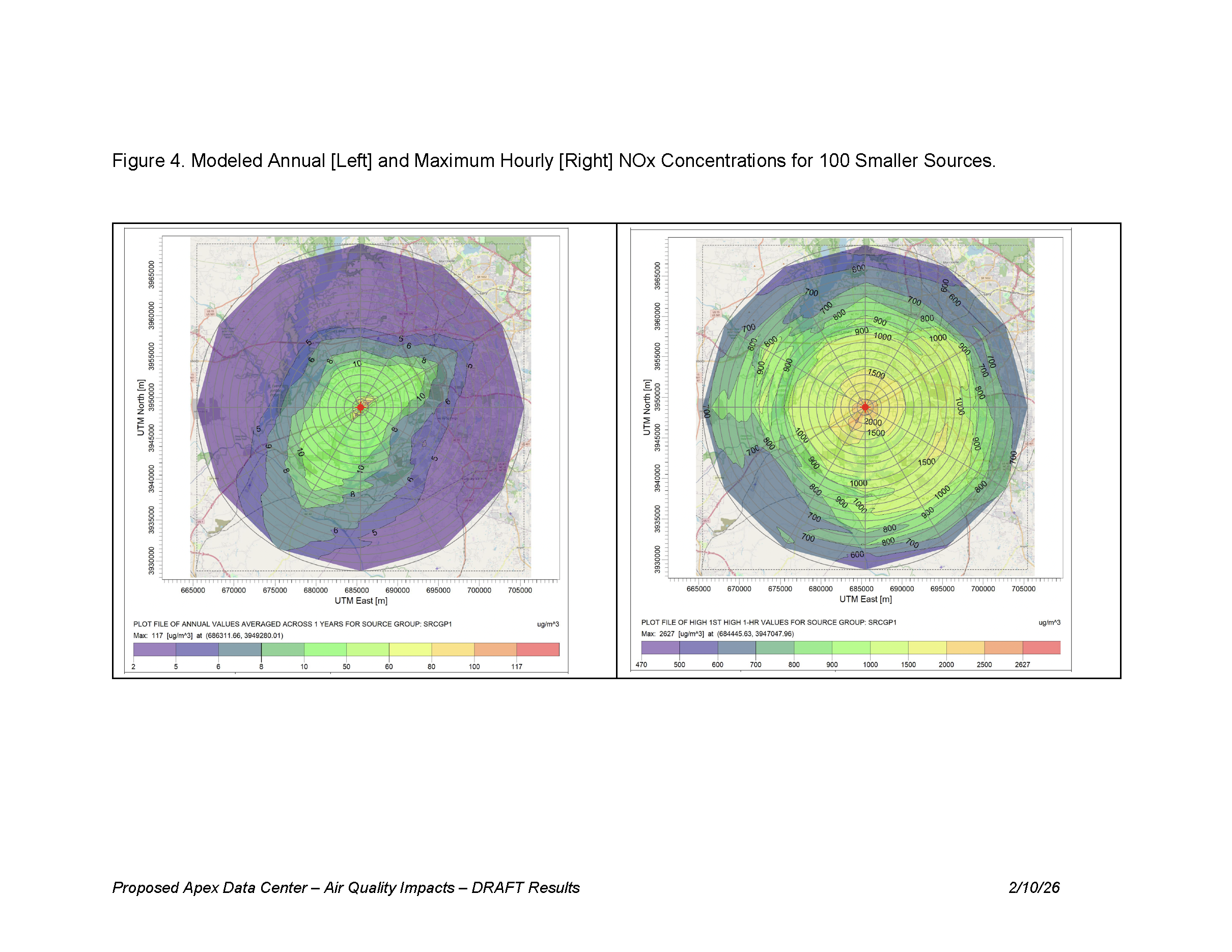
In Figure 4, the annual average impacts are > 100 µg/m3 just over a km from the facility, and a larger plume of between 10 – 50 µg/m3 is seen in a roughly 10-km radius all around the facility. Correspondingly, the maximum single hour concentration values are in the several hundreds of µg/m3 range spread more like a pancake all around the facility over a 15 - 20 km radius, with the maximum impact being > 2,500 µg/m3 within the first 1 – 2 km from the facility. Comparing these predictions with the NAAQS for Nitrogen Dioxide (NO2), a primary component of NOx, at 188 µg/m3 (over 1 hour) and 100 µg/m3 (annually) indicates air quality levels would be exceeded by more than double a km away while the maximum impact is 250 times the current NO2 NAAQS designed to protect public health.
While the modeled impacts I presented are from oxides of nitrogen, these gases go on to form fine particulate matter, particles of size less than 2.5 microns (or micrometers) through various physical and chemical processes. A micrometer is 1 millionth of a meter. The 2.5 micron size is roughly 1/20 of the width of a human hair. Exposure to air pollution from fine particulate matter is the single largest global environmental health risk, with about 8M people dying prematurely each year. In the U.S. alone, that number is about 100,000 per year. Short-term exposure triggers acute symptoms, while long-term exposure increases chronic disease risk and mortality. Recent studies in the epidemiological literature have also shown impacts on pregnant women leading to premature birth, autism, and also cognitive decline, leading to increased risk for neurodegenerative diseases like Alzheimer’s.
So, in the town at the Peak of Good Living, you may have the vulnerable population – children and older adults being affected the most, not to mention healthy adults also showing new adverse symptoms due to exposure to this pollution from the first data center. Due to cognitive decline, it is possible that test scores of students of Southwestern Wake county and likely Chatham county are negatively affected.
To conclude, while there are several concerns related to the proposed data center - excess emissions that affect the quality of air we breathe, excess demand on water that will strain the local resources, excess noise that will affect sleep, excess costs to consumers due to higher electricity bills, the question that I implore you to ask yourselves is: Are there really any benefits in any form to the Town of Apex and its residents that exceed the cumulative costs due to the proposed Data Center?
Thank you for the opportunity to provide this testimonial, and for your time today.
I look forward to being back on a future date to talk about the 2nd Data Center to provide a contrast to the first one that I presented today.
I look forward to learning more about how to prevent sources of air pollution from Dr. Arunachalam as well as from other sources and understand for the 2nd Data Center he plans to speak about the new public library coming to our neighborhood in New Hill! Please let others know we do not want to live by industrial-sized data centers or other factories emitting air pollution.
Part 2: Comments to the Apex Town Council February 24, 2026
Good evening, Mayor Gilbert, members of the Apex Town Council and Town staff: My name is Sarav Arunachalam, a 26- year resident of Apex and I reside at … and glad to be back today. I am a Chemical Engineer and Professor of Environmental Sciences and Engineering at UNC Chapel Hill.
I had given additional details on my professional background at the first round of comments I made two weeks ago on February 10. On that day, I gave part one of my narrative on a tale of two Data Centers. In the first Data Center, the one proposed for New Hill, I identified how generating backup power for a 300 MW data center on-site is akin to having a polluting power plant in the town with its motto “Peak of Good Living”. The onsite backup generators are expected to run for multiple hours over the period of a year for testing, and then for backup power for the Data Center should there be a power outage or emergency from Duke. These backup generators, likely to be powered by a fossil fuel - such as diesel or natural gas, will emit multiple harmful gases as well as soot that will lead to formation of fine particulate matter (or PM2.5) at downwind distances. Although these generators are only used during emergencies, they can have outsized health impacts , emitting more nitrogen oxides than natural gas plants. Emissions of Nitrogen Oxides (NOx) from diesel-fired emergency engines are 200 to 600 times greater, per unit of electricity produced, than new or controlled existing central power plants fired on natural gas, per the South Coast Air Quality Management District, which manages air quality for LA, the smoggiest city in 1 the U.S., despite historic improvements in air quality during the past several decades.
If you would like a visual of how fine particles are formed, when you peel a citrus fruit like orange, the spray that you get from the orange contains hundreds and perhaps thousands of small liquid droplets or aerosols, which are invisible to the human eye, but you just created these aerosols, i.e., a solid particle or droplet suspended in air. Why are such small particles important? Given their very small size, fine particulate matter (PM2.5) causes serious health issues by entering deep into the lungs and bloodstream, leading to respiratory problems (aggravated asthma, bronchitis, reduced lung function), cardiovascular issues (heart attacks, stroke, irregular heartbeat, heart failure), premature death, and potentially lung cancer, with children, older adults, and those with existing heart/lung conditions being most vulnerable.
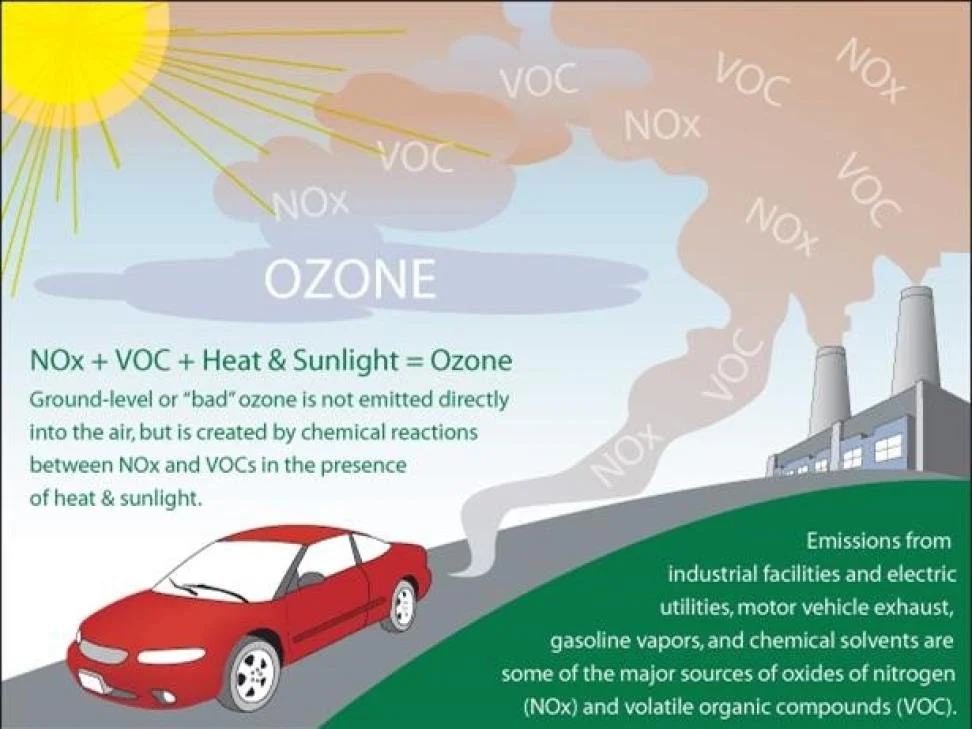
I will relate a study I performed in 2000 for ozone air pollution in North Carolina’s four major urban areas (including the Triangle region) which were in violation of the EPA’s National Ambient Air Quality Standard. Ground-level ozone is the result of a chemical reaction between pollutants—such as nitrogen oxides and volatile organic compounds, emitted by vehicles, power plants, refineries and other industrial sources—in the presence of sunlight. Working with the state DEQ and a team of investigators, I identified that Duke Energy’s coal-burning power plant emissions were the key contributors to ozone.
In advance of EPA regulatory actions, the state legislature then passed the Clean Smokestacks Act in 2002, a historic legislation that mandated Duke to significantly reduce emissions of nitrogen oxides and sulfur oxides from their units across the state. Through air quality modeling, I projected that North Carolina would have clean air in 2012 and published the study in 2006. As was projected, ground-level ozone levels dropped significantly in the next 2 decade, and the citizens of NC have since enjoyed clean air. A peer-reviewed study subsequently documented the statewide improvements in respiratory, cardiovascular, and cerebrovascular health in North Carolina due to the enforcement of the Clean Smokestacks Act. Death rates from respiratory illnesses like asthma, emphysema and pneumonia drastically declined, which saved the citizens of North Carolina substantially in health costs.
Now, I would like to turn your attention to the 2nd Data Center. This data center is not powered by diesel generators, does not run large computer servers, does not put the equivalent of four Super Walmarts near a residential area, does not have a humming sound, and does not deal with bits and bytes. However, it is expected to have perhaps 100,000 rectangular blocks that one can hold in their hands. These blocks are made of paper, and they have valuable information of all kinds. Silence is a virtue at this Data Center. When the children and citizens of Apex are exposed to these blocks, their overall knowledge increases, and they have cognitive progress (rather than decline as has been documented when exposed to pollution from the first kind of a Data Center). I am referring to the approved and planned new Data Center aka Wake County Library that is coming up near the intersection of Humie Olive and Old US1. “ The more that you read, the more things you will know. The more you learn, the more places you’ll go ” – Dr. Seuss.
We fully support such a Data Center. When you have more of this kind of a Data Center, you are expected to have the overall standard of the Wake County school system go up, and we offer a brighter future for our children, rather than send children who are affected by the first kind of Data Center to the new planned Children’s Hospital in Apex. Imagine a scenario where one end of the town is the source of a health problem that is directly feeding to a newly built healthcare facility on the other side of town. I am sure you would like to see more and more bright minds come out of our community like the very eloquent young man the town’s Mayor Gilbert interviewed yesterday 3 during a live Facebook session. And such growth of young and bright minds can happen only when we foster the growth of the 2nd kind of Data Center, and not the first kind in a residential town that is appealing for suburban living, and calls itself the Peak of Good Living, and continues to be ranked as one of the top small towns in the country (like this week’s U.S. News and Report’s ranking).
I also would bring to attention the following two items that are of interest to the Town Council: a ) Interim report released last week from the NC Governor’s Energy Policy Task Force. This was created to “develop recommendations for how to manage increasing electricity demand while maintaining adequate, reliable, affordable, and clean electricity for North Carolina”. They highlight that in Duke Energy’s Integrated Load plan, the energy load in Carolina will increase between 16% and 60% over the next 15 years, while we only grew by 7% in the past two decades. They have made 9 preliminary recommendations in this report and expect to have refined and detailed recommendations by Feb 2027. b) As part of a $175M initiative to modernize coal plants, the current administration through the Department of Energy’s plan to award $35M to Duke Energy Carolinas to upgrade two coal-fired units at the Belews Creek Steam Station in Stokes County. This facility was one of the several units that I carefully studied in 2002 to address NC air quality issues, and that led to historic reductions then under the NC Clean Smokestacks Act and that led to improving the public health of NC citizens. It remains to be seen how this coal plant modernization by Duke to serve the state’s energy needs, will also protect the public health of its citizens. Looking to our neighboring state up North in Virginia, a total of 174 air quality permits for data center backup generators have been issued as of December 4 1, 2024, with more than half of them in Loudoun County, VA, also called the Data Center alley. From a preliminary analysis performed for these data centers, assuming that the actual emissions are only 10% of the permitted level, the Virginia data centers in Virginia could cause approximately 13-19 premature deaths each year and 14,000 asthma cases, among other health implications, resulting in a total annual public health burden of $220-300 million. So, that is a number that we want to think about.
To conclude, while there are several concerns related to the proposed data center - excess emissions that affect the quality of air we breathe, excess demand on water that will strain the local resources, excess noise that will affect sleep, excess costs to consumers due to higher electricity bills, the question that I implore you to ask yourselves is: Which of the two types of Data Centers would the Town Council prefer to have and promote for the welfare of its citizens? I look forward to being back at a future time to discuss the two reports that I mentioned. Thank you for the opportunity to provide this testimonial, and for your time and attention today.
UPDATED August 31, 2026
I provided the following comments to the North Carolina Department of Air Quality (DAQ) public hearing:
Hello Ms. Quinlan and DAQ staff:
As requested at last Thursday's public hearing, here are my written comments for the non-emergency reciprocating internal combustion engines (RICE) proposed rule 02Q.0807 amendments.
I also want to thank Mr. Shawn Taylor for answering many of my questions today and during previous discussions. I hope that these comments will be useful for this rulemaking as well as for the agency to consider in general for making improvements in our health and environment even if some comments may not be directly relevant to the proposed rule amendments.
Will the proposed rule change protect and improve our air quality or just give industry more flexibility at compliance and consistency with the emergency RICE rule? I trust the rule change will still require larger facilities to obtain Title V permits and not enable regulatory loopholes.
Even if the non-emergency RICE rule pertains to facilities that do not need a Title V permit, it's essential to consider cumulative impacts such as from multiple facilities operating under different names and built in clusters. For instance,one data center site might have multiple owners and apply for separate permits that are below the threshold required for a Title V permit review. The Title V threshold of 10 tons per year for NOx could be met by about 5 continuously running 500 kW Tier 4 Final diesel generators at one facility. However, we are seeing data center clusters with multiple facilities interconnected via fiber-optics cables under different ownership structures that could exist below Title V permit requirements.
I reviewed the Regulatory Impact Analysis (RIA) for this rule but the DAQ analysis does not evaluate transport of fuel via delivery trucks which will contribute additional diesel pollution to the communities. Table 1 provides information on Emission Factors for Regulated Pollutants from Engines including PM10 but omits PM2.5 requirements of 9.0 micrograms per cubic meter (μ g/m³), which was strengthened by the EPA NAAQS for PM in early 2024. I'd also like to see the impact analysis discuss frequency of testing RICE for maintenance and fuel consumption.
Given there is uncertainty around the number of facilities that may use the proposed exclusionary provisions according to the RIA, can DAQ place a limit on the number of facilities that can qualify if the new provisions are adopted to reduce cumulative impacts?
The amendments appear to allow industry to demonstrate potential emissions as actual emissions based on annual fuel consumption, hours of usage, and other factors. This approach is concerning as there are many factors involved in the calculations such as changing population density, wind directions, and more. This does not appear to be proactive to prevent pollution and appears to provide enforcement based on many assumptions. A proactive approach is shown in the modeling work provided below by Dr. Arunachalam (I provided information from the previous blog described above).
The rapid proliferation of small scale cloud data centers ranging up to hyperscale data centers, such as to run AI models or cryptocurrency mining, requires extraordinary power demands with many facilities burning diesel and natural gas fuels. Here's a study of one data center by a Harvard University researcher showing the current permitting is not even adequate to protect public health from 8 natural gas turbines and 51 diesel generators which will lead to many premature deaths!
Executive Summary
● This report evaluates the estimated public-health and economic impacts attributable to fine particulate matter (PM2.5) emissions from the permitted on-site power system at the Vantage Data Center in Loudoun County, Virginia. The analysis reflects operation at the facility’s maximum permitted annual emission limits.
● PM2.5 is widely recognized as one of the most harmful air pollutants to human health. Extensive scientific evidence shows long-term exposure to PM2.5 — even at levels below current federal standards — is associated with increased risks of heart disease, stroke, respiratory illness, asthma exacerbation, and premature death.
● Using the U.S. Environmental Protection Agency’s COBRA health impact model, the facility’s permitted emissions are estimated to result in between $53–99 million per year in health-related damages. These damages are driven primarily by an estimated 3.4 to 6.5 additional premature deaths per year across the impacted region, along with hospital admissions, asthma-related outcomes, and lost productivity.
● If annual impacts remain at this level, total estimated health damages would add up to $265–$495 million over 5 years and $1.59–$2.97 billion over 30 years (undiscounted), corresponding to approximately 17–33 premature deaths over 5 years and 102–195 deaths over 30 years. These totals reflect incremental PM2.5 exposure affecting a large metropolitan population, where even modest increases in annual-average exposure translate into significant population-level health impacts and substantial cumulative
health costs over the facility’s operating lifetime.
● Geographically, the largest estimated county-level annual-average exposure increase attributable to the facility occurs in Loudoun County (0.034 µg/m³). Because of its larger population, Fairfax County accounts for the largest share of estimated total population exposure (37.7%). Elevated exposure extends beyond Loudoun into Fairfax County, the District of Columbia, and parts of Maryland.
● At the community level, the highest estimated annual-average increases occur in Sterling (0.137 µg/m³), Dulles Town Center (0.117 µg/m³), Oak Grove (0.115 µg/m³), and Dranesville (0.108 µg/m³). More than 2.5 million people live in census tracts with estimated annual exposure increases greater than 0.01 µg/m³, including 54,700 residents in tracts above 0.1 µg/m³.
● Census tracts experiencing the highest estimated PM2.5 increases include large and diverse communities within Northern Virginia, with higher proportions of Hispanic and Asian residents relative to statewide averages and elevated Social Vulnerability Index (SVI) scores. In Loudoun County, the highest estimated exposure increases are concentrated in southeastern portions of the county, which include several areas
designated as Environmental Justice communities.
● According to EPA’s 2023 Air Quality Statistics, background PM2.5 levels in the affected region are already elevated relative to national averages and are close to the current federal annual standard. Emissions from the facility would therefore add to ambient pollution levels in communities that already experience substantial existing air-quality burdens.